
Surviving a Freight Downturn: How a Strong Business Credit File Keeps a Trucking Company Fundable in a 2026 Recession
When freight rates fall and loads get scarce, the trucking companies that survive are the ones whose business credit file lets them tap capital the others cannot reach. Damon Boswell and Ashley Boswell break down how a freight recession strains trucking cash flow, why a downturn is the worst time to start building business credit, how working capital, factoring, and equipment financing become lifelines only for a file that was built before the slump, and how the Blueprint system hardens a trucking company against the next cycle before it arrives.
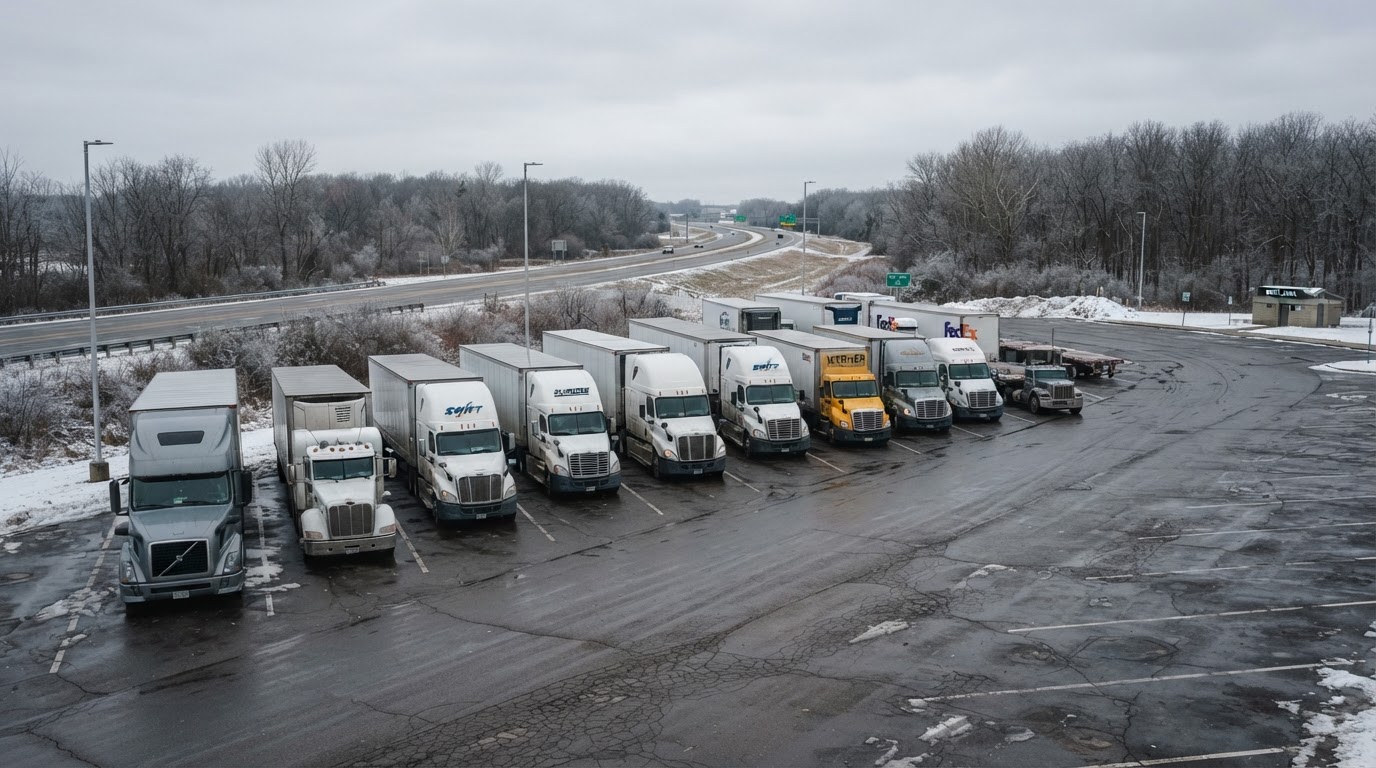
Damon Boswell has watched enough freight cycles to know the pattern by heart. When rates soften and loads thin out, the calls start the same way every time: a trucker who ran strong through the boom is suddenly squeezed, the broker payments have slowed, the fuel card is near its limit, and the bank is asking for a personal guarantee on a line of credit that used to approve on the EIN alone. The trucker wants to know what can be done right now to unlock working capital. Ashley Boswell gives the same hard answer each time: the work that opens that door needed to be done eighteen months ago, before the downturn began. A freight recession does not create a business credit problem, it exposes the one a trucking company never built.
In this guide, Damon Boswell and Ashley Boswell break down how a freight downturn strains a trucking company's cash flow in 2026, why a recession is the worst possible time to start building business credit from scratch, how working capital, freight factoring, and equipment financing become survival lifelines only for a file that was hardened before the slump, and how the Blueprint system builds a trucking company's credit file to be resilient through the next cycle before the cycle arrives. Because the trucker who built the file in the good times is the trucker who funds the business through the bad ones.
The Core Principle
Business credit is built in calm water so it can be used in the storm. A lender underwriting a no-PG line in a downturn reads the file for evidence the business can survive the cycle, and that evidence is payment history, tradeline aging, and a diversified credit mix that was built before the freight market softened. Damon Boswell and Ashley Boswell's rule: build the file when loads are strong, because the capital you need in a recession is the capital you cannot build during one.
How a Freight Downturn Strains Cash Flow
Ashley Boswell maps the mechanics of how a freight recession moves through a trucking company's books. When spot rates fall, every loaded mile earns less revenue against the same fixed costs, diesel, insurance, the truck payment, the driver or the owner's draw. When load availability shrinks, the truck spends more deadhead miles and more time sitting unpaid between loads, which lowers the revenue per truck per week while the overhead stays constant. When broker payment terms stretch from thirty to forty-five or sixty days as brokers themselves wait on shippers, the cash that was supposed to arrive in time to pay this week's fuel arrives a month late. Each one alone is survivable, but a freight downturn layers all three at once, and the company's cash position erodes faster than the books show.
Damon Boswell explains why this cascades into the credit file. The natural response to cash-flow strain is to lean on the available credit, which means the business credit card balance climbs, the fuel card runs near its limit, and net-30 vendor accounts get stretched to forty-five days. Each of those moves helps the cash flow in the short term and damages the business credit file in the medium term, because utilization climbs, payment timeliness slips, and the file that read as low risk during the boom starts reading as stressed exactly when the trucker needs it most. The downturn turns the credit file from an asset into a liability precisely when the trucker needs the asset.
- Falling spot rates lower revenue per mile while fixed costs stay constant.
- Fewer loads mean more deadhead and more unpaid sitting time between hauls.
- Stretched broker payment terms delay the cash that was timed to pay this week's fuel.
- The natural response, leaning on credit, raises utilization and delays payments.
- The file that was an asset in the boom becomes a liability in the bust.
Why a Downturn Is the Worst Time to Start Building
Damon Boswell is blunt about the timing problem. Business credit takes months to build, not days. A tradeline opened today reports its first payment in roughly thirty to sixty days, and a meaningful payment history takes six to twelve months of consistent on-time payments to move the scores. A D-U-N-S Number filed today does not produce a PAYDEX for months. In a freight downturn, a trucker who needs working capital in ninety days cannot build the file that would unlock it in ninety days, because the file is not ready when the need arrives. The capital is always behind the credit, and the credit is always behind the calendar.
Ashley Boswell adds the underwriting dimension. A lender reviewing a no-PG application during a recession underwrites for survival, not growth. The lender looks for evidence the business was stable and well-managed before the market softened, which means the file needs six to twelve months of clean history built during a period of strength. A file that was opened during the downturn and carries only recession-era data reads as a business with no track record of surviving a cycle, which is exactly the risk the lender is trying to avoid. This is why the truckers who fund through a recession are almost always the ones whose Blueprint was built the year before.
You build the roof before it rains. The trucker who starts a business credit file in a downturn is standing in the storm holding lumber.
The Boswell Resilience Rule
Damon Boswell and Ashley Boswell tell every client: the time to build business credit is when the truck is loaded and the rates are strong, because the capital you will need in the next downturn is the capital you cannot build during one. A file built in calm water is the one a lender funds in the storm.
The Lifelines That Only a Built File Can Reach
Damon Boswell identifies the three capital tools that keep a trucking company alive in a freight downturn, and explains why each one is only available to a file that was built before the slump. The first is working capital. A no-PG working capital line is a revolving credit facility underwritten on the business's receivables and credit file, and it lets a trucker cover fuel and payroll while waiting on broker payments without liquidating cash reserves. In a downturn, a working capital line is the difference between keeping the truck rolling and parking it for lack of fuel money, but the line only approves on a file that shows payment history and tradeline aging built during a period of strength.
The second lifeline is freight factoring. Factoring converts unpaid broker invoices into immediate cash, advancing a percentage of the invoice and collecting from the broker on the trucker's behalf. In a downturn when broker terms stretch, factoring is how a trucker gets paid this week on a load that pays in sixty days, but the best factoring rates and the non-recourse programs that protect against broker default are reserved for trucking companies whose business credit file demonstrates stability. Ashley Boswell notes that a trucker with a thin or stressed file can still factor, but at higher discount rates that eat the already-thin recession margins, while a strong file accesses the lower-cost programs that keep the math working.
The third lifeline is equipment financing for maintenance and upgrades. In a downturn, a truck that breaks down is an existential threat, because the lost revenue from a sidelined truck against the same overhead can sink a small fleet. Equipment financing and repair financing let a trucker replace an engine or a transmission without draining operating cash, and no-PG equipment financing is available only to a file that proves the business can service the debt on its own EIN. A trucker who built the file in the boom can finance the repair and keep rolling, while the one who didn't is choosing between a dead truck and empty reserves.
- Working capital line — covers fuel and payroll while broker payments stretch, approved on a built file.
- Freight factoring — converts slow broker invoices to immediate cash, best rates for a strong file.
- Equipment and repair financing — funds a breakdown fix without draining cash, no-PG on a mature file.
- Each lifeline is only reachable by a file built before the downturn began.
- A thin file still qualifies for some tools, but at rates that eat recession-thin margins.
Hardening the File Before the Next Cycle
Ashley Boswell lays out the resilience playbook the Blueprint system uses to harden a trucking company against the next downturn. The foundation is a compliant entity, a dedicated business bank account, and a D-U-N-S Number, established and reporting so the file exists and accumulates history. On top of that, a three-type credit mix, a net-30 vendor account, a revolving business credit card, and a reporting fuel card, is built so the file reads as diversified and low-risk. Every payment is made early, the oldest tradeline is never closed, and utilization is kept under ten percent on the statement cycle so the file never reads as stretched even during heavy months.
Damon Boswell adds the cushion layer. A hardened file is not just one that reads as strong today, it is one that has the headroom to absorb stress without breaking. That means a utilization ratio low enough that a heavy fuel month does not max the card, a tradeline count high enough that one late broker payment does not collapse the payment history, and a working capital line already approved and sitting unused so it is available the day the broker terms stretch rather than the day after the cash runs out. The cushion is built in the boom so it is there in the bust.
The Boswell Cushion Rule
Damon Boswell and Ashley Boswell build every client a cushion, not just a file: a working capital line approved and unused, utilization low enough to absorb a heavy month, and enough tradelines that one strained payment does not undo the history. A file with a cushion survives the cycle; a file without one breaks at the first stress point.
How Resilience Fits the 3-Step Blueprint
Damon Boswell and Ashley Boswell build the file for resilience through the three steps, because a downturn-ready file is built the same way a fundable file is, just with the timing deliberately set before the market turns.
Step 1 — Compliance & Foundation Audit
Ashley Boswell confirms the entity, EIN, D-U-N-S Number, and business bank account, and pulls the baseline three-bureau reports to see where the file stands relative to a downturn-ready profile. Any foundation gaps are closed while the market is still strong so the file accumulates history before the cycle turns.
Step 2 — Build Reporting Trade Lines
Damon Boswell opens the three-type mix of net-30 vendor, revolving card, and reporting fuel card, building the payment history and aging that a lender will underwrite against when the market softens. Every payment is early, the oldest account stays open, and utilization stays under ten percent.
Step 3 — Unlock No-PG Fleet Capital
With a mature, diversified, low-utilization file, Damon Boswell and Ashley Boswell unlock the no-PG working capital line and equipment financing the trucking company qualified for, and leave the working capital approved and unused as the cushion that absorbs the next downturn without the trucker scrambling for capital mid-crisis.
Common Recession Mistakes to Avoid
- Waiting until rates fall and loads thin before starting a business credit file.
- Leaning on the business credit card to cover a cash-flow gap and spiking utilization at the worst time.
- Letting broker payment delays push net-30 vendor accounts past their terms and denting PAYDEX.
- Closing the oldest tradeline during a cash crunch and erasing the aging that signals stability.
- Assuming factoring and working capital are available to any file, when the best rates need a built one.
- Draining cash reserves on a breakdown instead of financing it on a no-PG file.
- Failing to secure an unused working capital line during the boom so it sits ready for the bust.
The Bottom Line from Damon & Ashley
A freight downturn does not create a business credit problem, it exposes the one a trucking company never built. The capital that keeps a carrier alive in a recession, a working capital line, low-cost factoring, and no-PG equipment financing, is only reachable by a file that was hardened during a period of strength, because the months of payment history and tradeline aging a lender underwrites against cannot be built in the ninety days a trucker has before the cash runs out. Damon Boswell and Ashley Boswell built the Blueprint system to harden the file in calm water, with a three-type mix, early payments, low utilization, and an unused working capital cushion, so the trucker who built the roof before the rain is the trucker whose business keeps rolling through it.
If your trucking company is running strong right now and you have not built a business credit file, or if you want to add the working capital cushion before the next cycle turns, Damon Boswell and Ashley Boswell can audit your three-bureau reports, map the gap between your current file and a downturn-ready profile, and show you exactly how to build the resilience before you need it. Request a three-bureau credit audit and find out where your file stands today.