
The Trucking Business Credit Building Timeline: Your First 90 Days and Beyond in 2026
Building business credit is not instant—there is a reporting lag, a scoring phase, and a lender-ready phase, and most truckers quit before the file matures. Damon Boswell and Ashley Boswell break down the real timeline of a trucking business credit build in 2026, what happens at day 30, 60, and 90, when the first scores appear, and exactly what milestones to hit before applying for no-PG fleet capital.
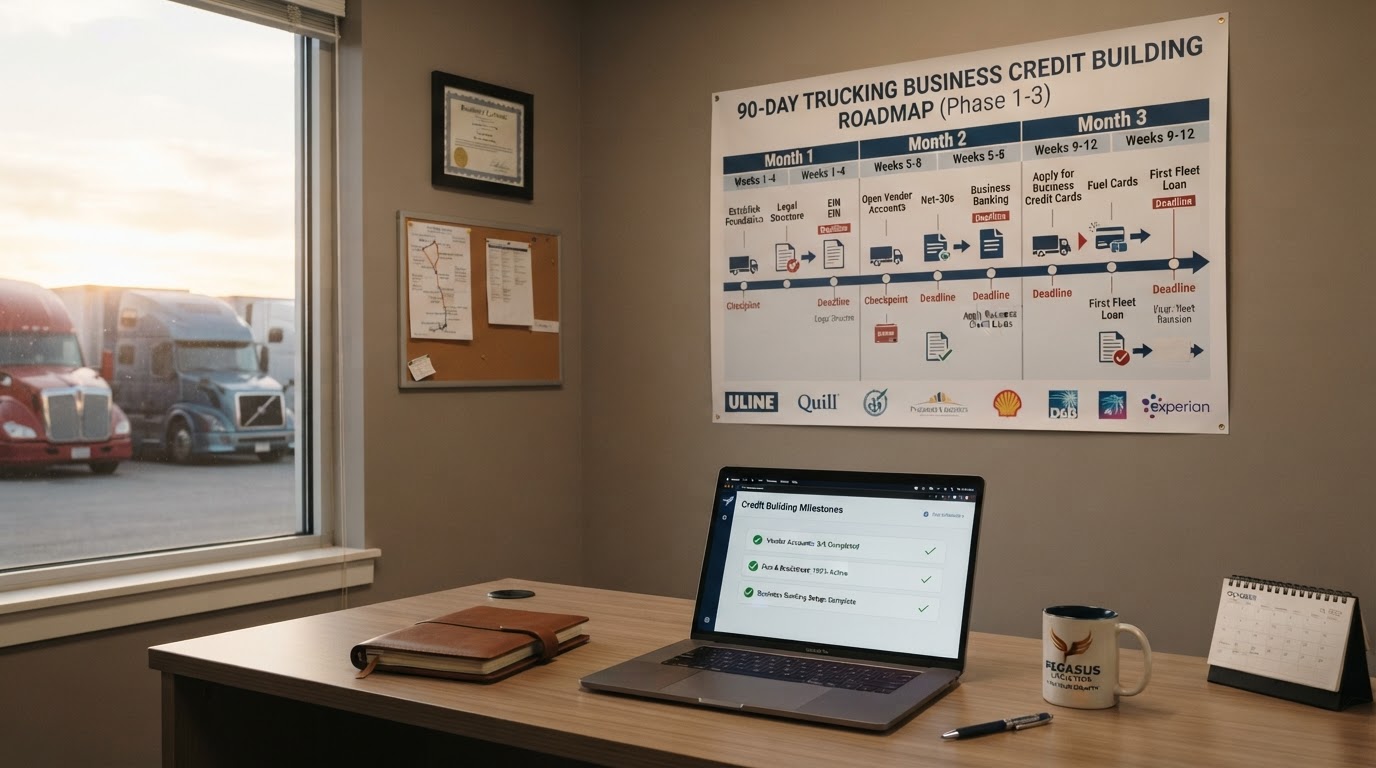
Damon Boswell hears the same question in every first call: how long does this take? The honest answer, the one most credit-building services will not give, is that a trucking business credit file is not built in a week or a month. There is a reporting lag of roughly 60 to 90 days before a new tradeline even appears on the credit report, a scoring phase that begins once enough tradelines report, and a lender-ready phase that typically takes 12 to 24 months to reach. The truckers who quit at day 45 because nothing has shown up yet are the truckers who never build the file that unlocks no-PG fleet capital. Ashley Boswell built the Blueprint timeline so every client knows exactly what milestone to expect and when, so no one abandons a build that is working exactly on schedule.
In this guide, Damon Boswell and Ashley Boswell break down the real timeline of a trucking business credit build in 2026, what happens at day 30, 60, and 90, when the first scores appear, what the milestones are for the first year and beyond, and exactly what to hit before applying for no-PG fuel cards, equipment financing, and working capital. Because the trucker who knows the timeline is the trucker who finishes the build.
The Core Principle
Business credit is a marathon with a predictable map. Damon Boswell and Ashley Boswell's rule: expect a 60 to 90 day reporting lag before the first tradeline appears, first scores around day 90 to 120, and a lender-ready profile in 12 to 24 months. The build is working even when the report looks empty—patience on the timeline is the discipline.
Why the Reporting Lag Exists
Ashley Boswell explains the lag that confuses every new client. When a trucker opens a net-30 vendor account and makes a purchase, the vendor does not report that payment to the bureaus instantly. Vendors report on their own cycles—often monthly—and the bureaus then take time to ingest and reflect the data. It typically takes 60 to 90 days for a new tradeline to appear on the credit report, which means a trucker who opens an account in week one may not see it on the file until month three. The absence of the tradeline in month one is not a failure; it is the normal reporting lag.
Damon Boswell stresses that this lag is why sequencing matters. Because the first tradeline takes up to 90 days to appear, the Blueprint system opens the foundational tradelines early and staggers the rest, so that by the time the first accounts report, the next ones are already in the pipeline. A trucker who waits to see the first tradeline before opening the second loses three months of aging; a trucker who staggers the openings builds age and mix in parallel from day one.
- Vendors report on their own cycles, often monthly—not instantly.
- It typically takes 60 to 90 days for a new tradeline to appear on the report.
- An empty report in month one is the normal lag, not a failure.
- Stagger tradeline openings so age and mix build in parallel.
- Waiting to see the first tradeline before opening the next wastes months of aging.
Day 30 — The Foundation
Damon Boswell maps the first 30 days to the foundation work that has to be complete before any tradeline reports. By day 30, the entity is formed, the EIN is issued, the D-U-N-S Number is requested, the dedicated business bank account is open, the 411 listing is verified, and the first net-30 vendor accounts are opened with an initial purchase placed on each. Nothing has appeared on the credit report yet, but the foundation is set and the reporting clock has started. Ashley Boswell uses day 30 to confirm that every foundational record matches across the IRS, the state, Dun & Bradstreet, and the bank, because a single mismatch stalls the file before it starts.
Day 60 — The First Tradelines Reporting
Ashley Boswell marks day 60 as the point where the first tradelines typically begin to appear on the report, assuming the vendor reporting cycles align. The trucker may see the first net-30 vendor account reflected, though no score has been calculated yet because Dun & Bradstreet generally needs at least three trade experiences from at least two suppliers before it calculates a PAYDEX. Day 60 is also when Damon Boswell opens the next layer—a revolving business credit card and a reporting fuel card—so the file develops a credit mix while the first accounts age.
Day 90 — The First Scores Appear
Damon Boswell identifies day 90 as the inflection point. By the 90 to 120 day window, with enough reporting tradelines in place, the first scores typically begin to appear. The PAYDEX may register once three trade experiences from at least two suppliers report, and the Intelliscore and Equifax Payment Index begin to take shape as the data thickens. This is the moment a trucker often expects a finished file and instead sees a young, thin one—but the scores appearing means the build is working. The work from here is to keep every payment early, add tradelines to strengthen the profile, and let the age compound.
Day 90 is when the scores show up and most truckers panic because the numbers look thin. That's not a problem—that's the build starting to work. The thin file at day 90 is the strong file at month 12, if you keep paying early.
The Boswell Timeline Rule
Damon Boswell and Ashley Boswell tell every client: day 30 is the foundation, day 60 is the first reporting, day 90 is the first scores, month 4 to 12 is the score-growth phase, and month 12 to 24 is the lender-ready phase. Never judge the build before day 90, and never stop paying early before month 24.
Months 4 to 12 — The Score Growth Phase
Ashley Boswell describes the score growth phase that runs from roughly month four through the first year. Scores start to strengthen as sufficient tradelines report, and the trucker adds additional tradelines to strengthen the credit profile. The PAYDEX pushes toward 80 and beyond as early payments compound, the Intelliscore moves into the low-risk band as the mix and age build, and the Equifax Payment Index stabilizes in the 90 to 100 range. This is the phase where discipline compounds: every early payment lifts every bureau, and every month of age adds stability the file did not have before.
Damon Boswell uses this phase to prepare for Step 3. The file is not yet lender-ready, but it is approaching it. He monitors all three bureaus quarterly to ensure no bureau falls behind, confirms every tradeline is still reporting, and protects the oldest accounts. The trucker who maintains the early-payment habit through this phase arrives at month 12 with a file that reads as low-risk across all three bureaus.
Months 12 to 24 — The Lender-Ready Phase
Damon Boswell marks the lender-ready phase as the window where a mature, diversified, seasoned file unlocks no-PG fleet capital. With a PAYDEX of 80 or above, an Intelliscore in the low-risk band, an Equifax Payment Index at 90, and 12 to 24 months of consistent reporting across a three-type mix, the trucking company presents a profile a no-PG lender can underwrite on the EIN alone. This is when Damon Boswell and Ashley Boswell apply for the high-limit fuel cards, equipment financing, and working capital the build was engineered to unlock—each application made only when the file is ready to approve.
Ashley Boswell notes that the exact timing depends on the trucker's starting point, the tradelines opened, and the consistency of early payment. A trucker who starts with a clean entity and follows the sequence can reach lender-ready toward the earlier end of the window; one who starts with gaps or inconsistent payments moves toward the later end. The timeline is a map, not a guarantee, but the milestones are predictable for the trucker who follows them.
- Day 30 — entity, EIN, D-U-N-S, business account, and first net-30 purchases in place.
- Day 60 — first tradelines begin to appear; next layer opened for credit mix.
- Day 90 to 120 — first scores appear as enough tradelines report.
- Months 4 to 12 — score growth phase; PAYDEX pushes toward 80 and beyond.
- Months 12 to 24 — lender-ready phase; no-PG fleet capital unlocks on the EIN.
How the Timeline Fits the 3-Step Blueprint
Damon Boswell and Ashley Boswell map the three steps directly onto the timeline, so every client knows which step they are in and what milestone comes next.
Step 1 — Compliance & Foundation Audit (Day 0 to 30)
Ashley Boswell completes the entity, EIN, D-U-N-S, business account, and 411 verification, and opens the first net-30 vendor accounts. The foundation is set and the reporting clock starts.
Step 2 — Build Reporting Trade Lines (Day 30 to Month 12)
Damon Boswell staggers the net-30, business credit card, and reporting fuel card openings, drives every payment early, and monitors all three bureaus quarterly. The first scores appear around day 90 and grow through the first year.
Step 3 — Unlock No-PG Fleet Capital (Month 12 to 24)
With a mature, low-risk three-bureau file, Damon Boswell and Ashley Boswell unlock the no-PG fuel cards, equipment financing, and working capital the trucking company qualified for—the payoff of a build run on schedule.
Common Timeline Mistakes to Avoid
- Quitting at day 45 because no tradeline has appeared yet, mistaking the lag for failure.
- Waiting to see the first tradeline before opening the next, wasting months of aging.
- Expecting a lender-ready file at day 90 instead of treating it as the first-scores milestone.
- Stopping early payments once the first scores appear, which stalls the score-growth phase.
- Closing old tradelines during the build, which resets the age the file needs.
- Applying for no-PG capital before month 12, which adds hard inquiries to an immature file.
- Not monitoring all three bureaus quarterly, so one bureau falls behind unnoticed.
The Bottom Line from Damon & Ashley
Building a trucking business credit file is a marathon with a predictable map, and the truckers who finish are the ones who know the timeline and trust it. Day 30 is the foundation, day 60 is the first reporting, day 90 is the first scores, month 4 to 12 is the score-growth phase, and month 12 to 24 is the lender-ready phase that unlocks no-PG fleet capital. Damon Boswell and Ashley Boswell built the Blueprint system to map every milestone, stagger every tradeline, and keep every payment early, so a trucking company arrives at the lender-ready window with a mature, diversified, low-risk file instead of abandoning a build that was working exactly on schedule.
If you do not know where you are on the timeline, or if you have been building for months and are unsure whether your file is lender-ready, Damon Boswell and Ashley Boswell can pull your three-bureau reports, map your milestones, and show you exactly where you stand and what to hit next. Request a three-bureau credit audit and find out where your trucking business credit build is on the 2026 timeline today.