
Truck Leasing vs. Buying: TRAC Lease, FMV, $1 Buyout & Business Credit in 2026
Should your fleet lease or buy its next Class 8 rig? Damon Boswell and Ashley Boswell break down TRAC leases, Fair Market Value (FMV) leases, $1 buyout leases, commercial loans, 2026 Section 179 tax math (100% bonus depreciation), and how each financing structure impacts your Dun & Bradstreet, Experian Business, and Equifax Small Business credit files—with zero personal guarantee.
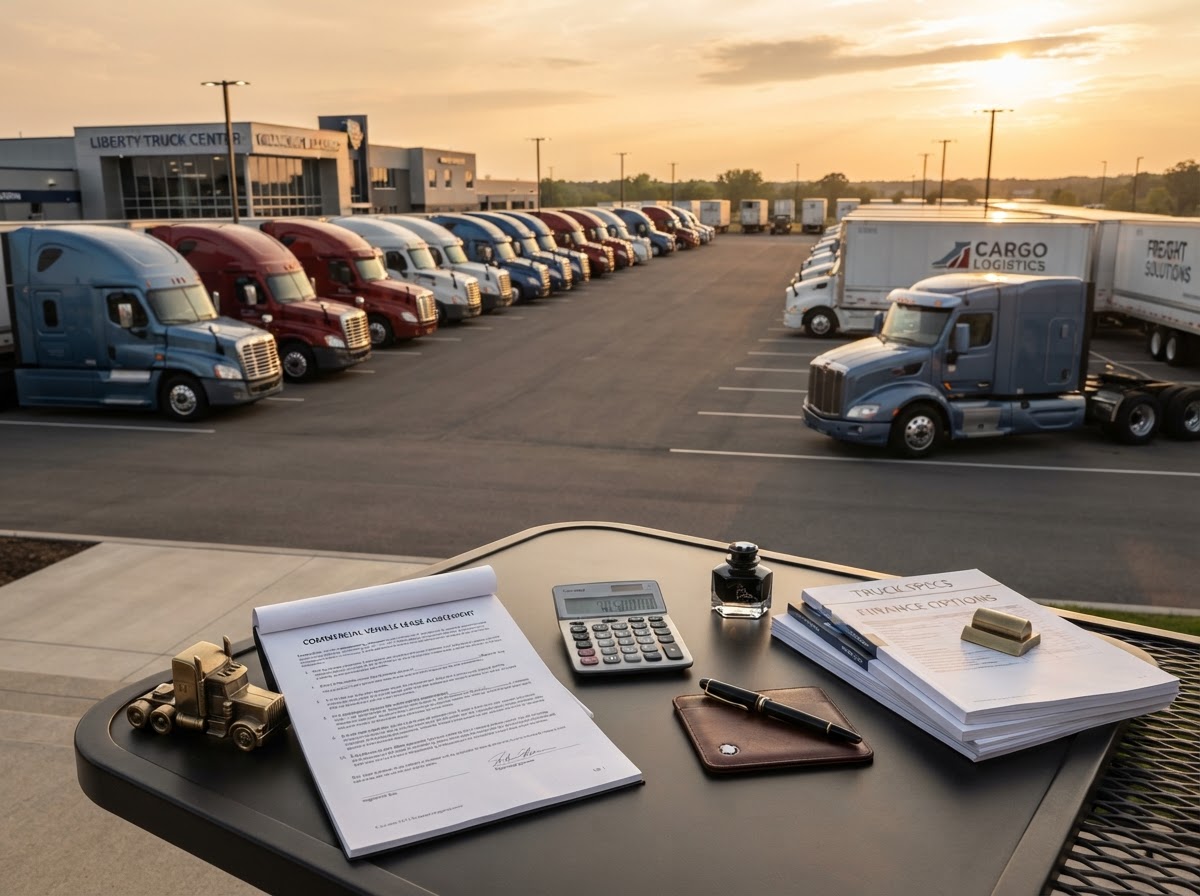
When an owner-operator or fleet manager prepares to add a Class 8 tractor or dry-van trailer to the fleet, one question dominates the table: should we lease or buy? Damon Boswell and Ashley Boswell sit down with motor carriers every week who believe leasing is always cheaper, or that buying is the only way to build real enterprise value. The reality, in Damon Boswell's experience, is that neither structure is inherently superior—they solve completely different financial and tax problems. The wrong choice can lock up $150,000 in unnecessary capital or trigger a surprise tax bill, while the right choice accelerates cash flow, maximizes tax write-offs, and builds a massive no-personal-guarantee business credit profile.
In this guide, Damon Boswell and Ashley Boswell break down the exact mechanics of commercial truck acquisition in 2026: traditional equipment loans versus Terminal Rental Adjustment Clause (TRAC) leases, Fair Market Value (FMV) leases, and $1 buyout capital leases. They walk through the 2026 Section 179 deduction and 100% bonus depreciation rules, analyze real monthly payment comparisons on a $150,000 rig, and reveal how each structure reports to Dun & Bradstreet, Experian Business, and Equifax Small Business so your entity builds a PAYDEX score without ever risking your personal credit.
The Core Principle
A lease vs. buy decision is not just about monthly payments; it is a balance-sheet and credit-building strategy. Damon Boswell and Ashley Boswell's rule: use a loan or $1 buyout lease when you intend to run the truck past payoff and build long-term asset equity; use a TRAC or FMV lease when you want lower monthly payments, tax-deductible lease expenses, and the ability to cycle equipment every 3 to 5 years without residual risk.
Commercial Truck Loan (Financing) Overview
Damon Boswell starts with the traditional commercial truck loan. Under a loan structure, your trucking company borrows the capital to purchase the truck, takes title at closing (with the lender holding a lien), and amortizes the principal and interest over a term typically ranging from 36 to 84 months.
Ashley Boswell highlights the chief benefit of a loan: equity building. Every monthly payment reduces the loan principal and increases the company's net asset value. Once the loan is paid off, the truck is owned free and clear, leaving the business with zero monthly debt payments and a tangible asset that can be run for profit, sold, or pledged as collateral for working capital.
- Ownership — your business holds title from day one; lender holds a security lien.
- Down payment — typically requires 10% to 30% down depending on business credit tier and equipment age.
- No mileage or wear restrictions — drive as many miles as your freight demands without excess mileage fees.
- Customization — complete freedom to modify, wrap, or install auxiliary power units (APUs) and electronic logging devices (ELDs).
- Balance sheet impact — the truck appears as a capital asset, while the loan appears as a liability.
Commercial Truck Lease Structures Explained
Damon Boswell and Ashley Boswell divide commercial truck leases into three distinct structures. Understanding the fine print of each is critical before signing any lease agreement.
1. TRAC Lease (Terminal Rental Adjustment Clause)
The TRAC lease is the single most popular leasing structure in the commercial trucking industry. Under a TRAC lease, the lessor and lessee agree upfront on an estimated residual value for the truck at lease end (e.g., $45,000 on a $150,000 truck after 60 months). Your monthly lease payments cover only the estimated depreciation plus a money factor (interest rate).
Damon Boswell explains the terminal adjustment: at lease end, the truck is appraised or sold. If the truck sells for $52,000 (above the $45,000 residual), the leasing company pays your business the $7,000 surplus. If the truck sells for $38,000 (below residual), your business pays the $7,000 shortfall. This terminal adjustment risk allows TRAC leases to qualify for lower monthly payments while giving the carrier full operational control.
2. Fair Market Value (FMV) Lease
An FMV lease (often called an operating lease) offers the lowest monthly payment because the lessor retains the entire residual value risk. At the end of the term, your business can return the truck, extend the lease, or purchase the truck at its current fair market value. However, FMV leases enforce strict annual mileage limits (e.g., 100,000 miles/year) and wear-and-tear standards, with penalties for exceeding them.
3. $1 Buyout Lease (Lease-to-Own)
A $1 buyout lease is essentially a loan structured as a lease for legal or accounting purposes. You make fixed monthly payments over the term, and at the end of the lease, you purchase the truck for exactly $1. Monthly payments are higher than a TRAC or FMV lease—identical to a standard loan—but you guarantee ownership at payoff without residual risk.
A TRAC lease gives you the low monthly payment of a lease with the upside of an owner. If you maintain your equipment and sell above residual, you pocket the check. That's why 70% of our fleet clients choose TRAC leases in Step 3.
Side-by-Side Monthly Payment Comparison ($150,000 Truck)
Ashley Boswell models the cash-flow impact for a client acquiring a $150,000 Class 8 semi-truck with 10% down ($15,000 down, $135,000 net cap cost) over a 60-month term at an effective 10% APR:
- Commercial Truck Loan — ~$2,868 / month (Finances full $135,000 balance; own truck at month 60).
- TRAC Lease (30% Residual / $45,000) — ~$2,250 / month (Saves ~$618/mo in cash flow; terminal adjustment at end).
- $1 Buyout Lease — ~$2,868 / month (Same payment as loan; buy truck for $1 at end).
- FMV Operating Lease — ~$2,100 / month (Lowest payment; strict mileage limits and return condition).
The Boswell Cash-Flow Insight
Damon Boswell and Ashley Boswell point out that saving $618 per month on a TRAC lease frees up $7,416 per year in working capital per truck. For a 5-truck fleet, that is $37,080 a year that can be reinvested into high-limit fuel cards, driver pay, or maintenance reserves.
2026 Tax Deductions: Section 179 & 100% Bonus Depreciation
Ashley Boswell emphasizes the massive tax advantage available in 2026. Under updated tax guidelines, Section 179 allows qualifying businesses to write off up to $2,560,000 of equipment purchases, while 100% Bonus Depreciation allows full first-year expensing for commercial vehicles with a Gross Vehicle Weight Rating (GVWR) over 14,000 lbs (which includes all Class 7 and Class 8 trucks).
Damon Boswell explains how this applies across structures: under a loan or $1 buyout lease, your business owns or capitalizes the truck, enabling you to deduct up to 100% of the purchase price in year one against your taxable freight income. Under an FMV or TRAC operating lease, your business deducts 100% of each monthly lease payment as a direct operating expense. Always consult your CPA to match the tax strategy to your entity's tax bracket.
How Lease vs. Buy Impacts Business Credit & No-PG Financing
Damon Boswell and Ashley Boswell view equipment acquisition through the lens of enterprise credibility. Whether you lease or finance, the reporting structure determines how your business credit profile grows.
Under the Blueprint Business Advisors 3-step system, an equipment lease or loan is underwritten on your entity's EIN—not your personal SSN—once your file reaches maturity:
- Step 1: Entity & Foundation Audit — verify clean LLC structure, EIN, 411 listing, and matching D&B / Experian / Equifax records.
- Step 2: Build Reporting Tradelines — establish net-30 vendor accounts and no-PG credit cards, driving early payments to build a 80+ PAYDEX and low-risk Intelliscore.
- Step 3: High-Limit Fleet Capital — unlock $50,000 to $250,000+ in equipment financing or TRAC leases on EIN alone without a personal guarantee.
When structured correctly in Step 3, every monthly lease or loan payment reports directly to Dun & Bradstreet, Experian Business, and Equifax Small Business. This heavy financial tradeline solidifies your company's credit standing, making future fleet expansions effortless.
Common Truck Acquisition Mistakes to Avoid
- Signing a personal guarantee on equipment financing when your business credit file qualifies for EIN-only underwriting.
- Choosing an FMV lease for high-mileage long-haul routes, resulting in heavy excess mileage penalties at lease end.
- Failing to factor in the TRAC lease terminal adjustment when calculating end-of-term cash obligations.
- Financing older, high-mileage trucks with short loan terms that create unsustainable monthly payments.
- Overlooking Section 179 and 100% bonus depreciation timing before fiscal year-end.
The Bottom Line from Damon & Ashley
Choosing between a truck lease and a loan is a strategic decision that shapes your cash flow, tax liability, and business credit profile. A commercial loan or $1 buyout lease builds long-term asset equity, while a TRAC lease optimizes monthly cash flow and provides tax flexibility.
Damon Boswell and Ashley Boswell built Blueprint Business Advisors to help trucking companies navigate equipment acquisition, structure no-PG financing, and build bulletproof three-bureau credit files. If you are preparing to acquire your next truck and want to explore EIN-only leasing and loan options, request a compliance credit audit with Damon & Ashley today.