
Tradeline Aging & Credit Mix: The Two Levers Truckers Ignore in 2026
Opening tradelines is only half the build. The age of your oldest account and the mix of vendor, card, and fleet tradelines are two of the most overlooked levers in a trucking business credit file—and both decide whether a no-PG lender sees stability or risk. Damon Boswell and Ashley Boswell break down how tradeline aging and credit mix move your PAYDEX, Intelliscore, and Equifax Payment Index, and why closing an old vendor account can quietly undo months of progress.
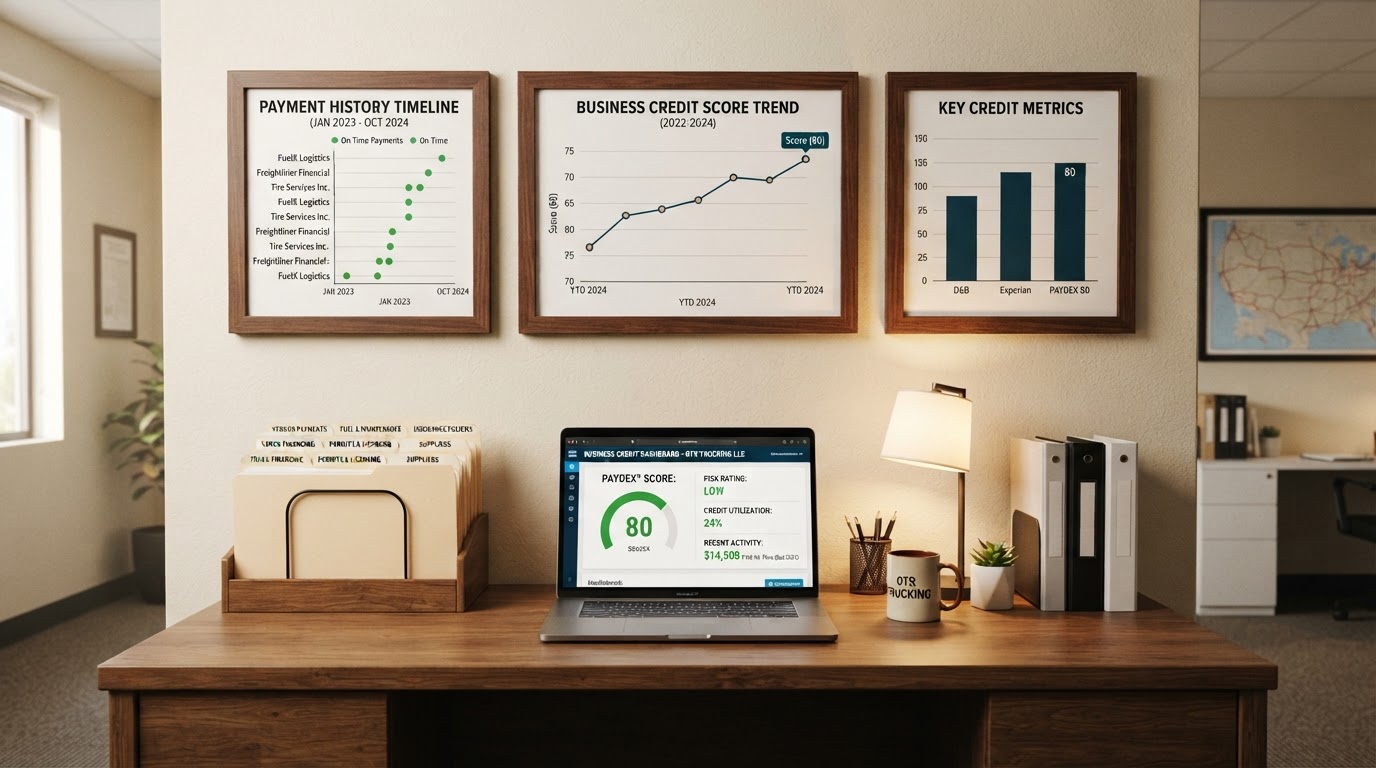
Damon Boswell sees the same pattern every time a trucker reaches Step 3 and a no-PG lender still hesitates: the PAYDEX is 80, the payments are early, the revenue is consistent—yet the file reads as thin. The reason is almost always the same two levers the trucker never pulled: tradeline aging and credit mix. The age of the oldest open account and the variety of account types in the file are weighted heavily by Dun & Bradstreet, Experian Business, and Equifax Small Business, because both signal stability. A trucker who opens three net-30 vendor accounts in the same month, pays them perfectly, and never adds anything else has a perfect payment history sitting on a one-dimensional, infant file. Ashley Boswell calls it the difference between a file that pays on time and a file that looks like it will still be paying on time five years from now.
In this guide, Damon Boswell and Ashley Boswell break down how tradeline aging and credit mix actually move a trucking business credit file in 2026, why older accounts carry more weight than newer ones, why a blend of vendor, card, and fleet tradelines outperforms a stack of identical accounts, and how the Blueprint system engineers both levers in parallel so a no-PG lender reads a mature, diversified, low-risk profile. Because the trucker who understands aging and mix is the trucker who builds a file that lasts.
The Core Principle
Payment history gets you to 80; tradeline aging and credit mix push you past it. Damon Boswell and Ashley Boswell's rule: never close your oldest reporting account, and build a blend of at least three account types—vendor, revolving card, and fleet—so every bureau reads a diversified, seasoned file rather than a one-dimensional snapshot.
What Tradeline Aging Actually Measures
Ashley Boswell defines tradeline aging as the length of time each open account has been reporting to the business bureaus, with two components that matter: the age of the oldest individual tradeline and the average age across all open tradelines. Both feed the stability signals a bureau uses to predict whether a business will keep paying on time. A file whose oldest account is two years old reads as more stable than a file whose oldest account is two months old, even if both have perfect payment history, because the bureau has more longitudinal evidence that the older business sustains its discipline over time.
Damon Boswell adds the nuance that older trade activity can carry less relevance over time or fall outside a bureau's eligible trade window, which is why maintaining current positive trade activity matters just as much as preserving old accounts. The Blueprint approach keeps the oldest accounts open and active with a small recurring purchase every few months, so the account continues to report fresh positive data while preserving its age. A dormant old account that has not reported in a year helps less than an active old account that reports every cycle.
- Age of oldest tradeline — the longest-running open account on the file.
- Average age of all tradelines — the mean age across every open account.
- Older accounts carry more weight because they show sustained discipline.
- Dormant old accounts lose impact if they stop reporting fresh data.
- Keep the oldest account open and active with a small recurring purchase.
Why Closing an Old Account Hurts
Ashley Boswell spends a lot of time undoing a single mistake: the owner-operator who closes an old net-30 vendor account because they no longer use the supplier. Closing an old account can shorten the average age of the open tradelines and, if that account had a long positive payment history that then stops reporting, the file can lose the very data that signaled stability. The impact depends on how many other accounts remain and how strong they are, but for a thin file with only a handful of tradelines, losing the oldest one can be the difference between a low-risk read and a moderate-risk read.
Damon Boswell's guidance is simple: unless an account carries a fee that outweighs its value, keep it open. A net-30 vendor account that costs nothing to keep open is worth preserving for its age alone, even if the trucker only places a small purchase on it twice a year to keep it active. The age is the asset; the spend is just the maintenance fee for keeping the asset alive.
Your oldest tradeline is the oldest proof you pay on time. Closing it to save a few dollars is like burning your longest reference letter before a job interview.
What Credit Mix Actually Measures
Damon Boswell defines credit mix as the variety of account types in the file. The bureaus reward a business that manages more than one kind of credit, because handling different account structures—vendor terms, revolving cards, and installment or fleet financing—demonstrates broader financial discipline than handling only one. A file with three identical net-30 vendor accounts shows the business can pay vendors. A file with a net-30 vendor, a revolving business credit card, and a reporting fuel card shows the business can pay vendors, manage a revolving balance, and handle a fleet line all at once—a far stronger signal of low risk.
Ashley Boswell notes that a mix of different account types is consistently cited as helpful for building good business credit, alongside the age of those accounts. The Blueprint system deliberately layers three account types so the file reads as diversified: a net-30 vendor tradeline for payment-term discipline, a revolving business credit card for utilization management, and a reporting fleet fuel card for high-volume operational spend. Each one feeds the bureaus slightly different data, and together they paint a complete picture of a business that handles its credit responsibly across the board.
The Boswell Mix Rule
Damon Boswell and Ashley Boswell build every client toward a three-type mix: at least one net-30 vendor account, one revolving business credit card, and one reporting fleet fuel card. A one-dimensional file is a fragile file; a diversified file is a fundable file.
How Aging and Mix Move Each Bureau
Damon Boswell walks through how the three bureaus weigh these levers. Dun & Bradstreet's PAYDEX is dominated by payment timeliness, but the companion scores—the Delinquency Predictor and the Failure Score—factor in the age and breadth of the trade experiences behind the PAYDEX. A PAYDEX of 80 backed by two-year-old, multi-type tradelines reads as lower risk than a PAYDEX of 80 backed by three-month-old, single-type tradelines. Experian's Intelliscore Plus explicitly blends account mix and age of credit into its predictive model alongside payment history, so a diversified, seasoned file lifts the Intelliscore beyond what payment history alone can do. Equifax Small Business similarly considers the depth and age of the trade data in its Payment Index and delinquency models.
Ashley Boswell summarizes the practical takeaway: a trucker who only builds one account type will hit a ceiling well below a trucker who builds a blend, because the blended file activates scoring factors the single-type file never touches. The ceiling is the reason a perfect-paying trucker still gets a moderate-risk read—the file is one-dimensional and young, so the bureau cannot confirm the discipline will hold across account types and over time.
- D&B PAYDEX — payment-driven, but companion scores weigh trade age and breadth.
- Experian Intelliscore Plus — explicitly blends account mix and age of credit.
- Equifax Small Business — considers depth and age of trade data in its models.
- A single-type file hits a ceiling a blended file breaks through.
- Older, multi-type tradelines lower the risk read across all three bureaus.
How Aging and Mix Fit the 3-Step Blueprint
Damon Boswell and Ashley Boswell engineer both levers deliberately through the three steps, rather than leaving them to chance.
Step 1 — Compliance & Foundation Audit
Ashley Boswell confirms the entity, EIN, and D-U-N-S Number, and pulls the baseline three-bureau reports to see the current age and mix of every open account. The gap between the current profile and a diversified, seasoned file is mapped as the build target.
Step 2 — Build Reporting Trade Lines
Damon Boswell opens a net-30 vendor account, a revolving business credit card, and a reporting fuel card in a staggered sequence so the file develops a mix and a natural age spread. Every payment is made early, and the oldest account is kept open and active for the life of the build.
Step 3 — Unlock No-PG Fleet Capital
With a mature, diversified three-bureau file, Damon Boswell and Ashley Boswell unlock the no-PG fuel cards, equipment financing, and working capital the trucking company qualified for. The lender reads a seasoned, multi-type profile that confirms low risk across every scoring dimension—not just payment punctuality.
Common Aging and Mix Mistakes to Avoid
- Closing the oldest vendor account because the supplier is no longer used.
- Opening three identical net-30 accounts and calling it a diversified file.
- Letting an old account go dormant so it stops reporting fresh positive data.
- Adding new tradelines too fast, which drags down the average age.
- Ignoring credit mix entirely and relying on payment history alone.
- Assuming a PAYDEX of 80 is enough when the file is young and one-dimensional.
- Churning accounts—opening and closing—which resets age and signals instability.
The Bottom Line from Damon & Ashley
Payment history gets a trucking company to a PAYDEX of 80, but tradeline aging and credit mix are the levers that push the file past it and keep it there. A diversified, seasoned file tells every bureau the same story: this business pays on time, has done so across multiple account types, and has done so long enough to trust. Damon Boswell and Ashley Boswell built the Blueprint system to engineer both levers deliberately—a three-type mix, a staggered opening sequence, and a commitment to never close the oldest account—so a no-PG lender reads a mature, low-risk profile instead of a thin, one-dimensional snapshot.
If your file is stuck at a ceiling despite perfect payments, or if your tradelines are all the same type and age, Damon Boswell and Ashley Boswell can pull your three-bureau reports, analyze your aging and mix, and show you exactly how to diversify and season the file to break through. Request a three-bureau credit audit and find out where your tradeline aging and credit mix stand today.