
SBA Loans for Trucking Companies: The 7(a) & Microloan Guide for 2026
An SBA 7(a) loan can put up to $5 million behind a trucking company, and a microloan can cover the gap when a carrier needs under $50,000—but both demand a credit profile most owner-operators never build. Damon Boswell and Ashley Boswell break down how the 7(a), 504, and Microloan programs actually work for trucking, the FICO SBSS 165 threshold that decides eligibility, and how a no-PG business credit file turns a government-backed decline into an approval in 2026.
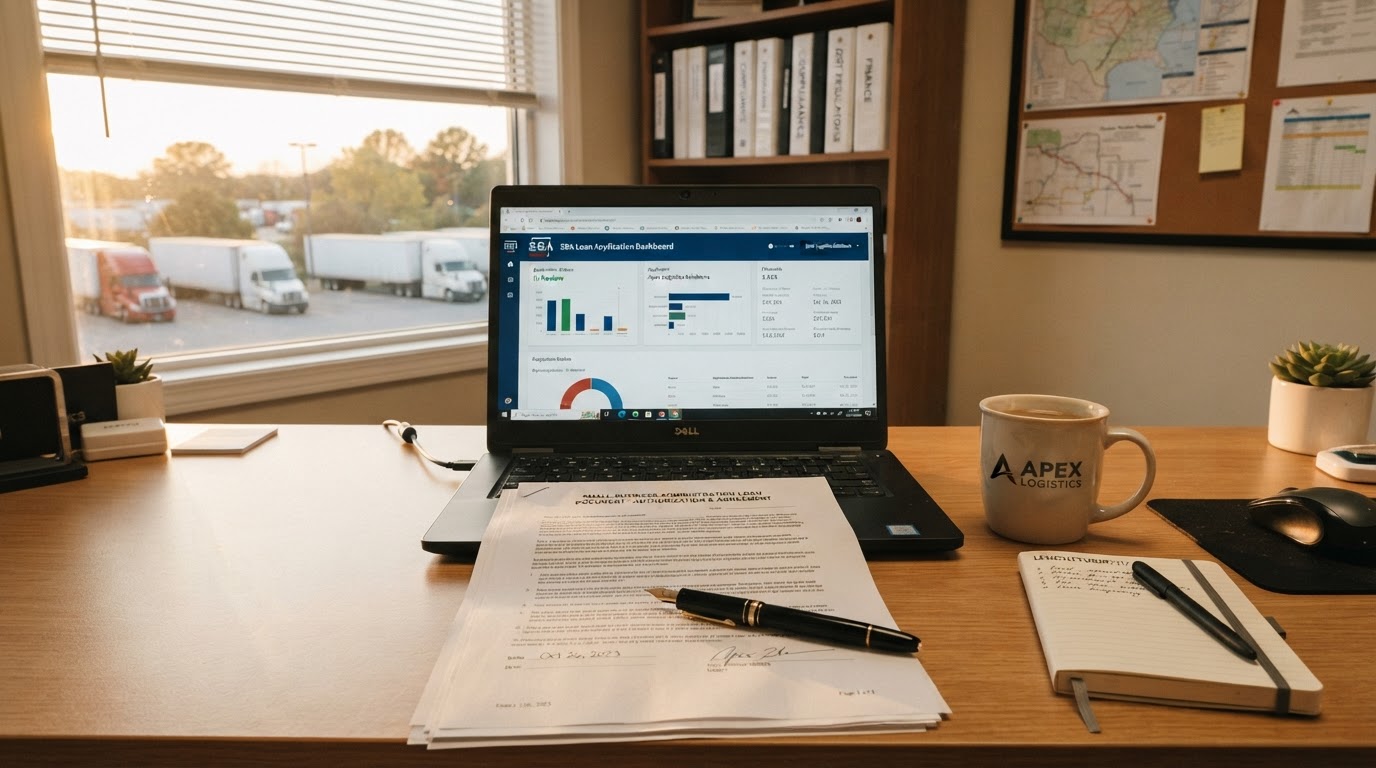
Ashley Boswell opens the SBA conversation the way she always does: by reminding the trucker sitting across from her that SBA does not lend money. The Small Business Administration does not write checks to small businesses; it guarantees a portion of a loan that a participating lender—typically a bank or a certified development company—extends to the business. That guarantee, which can cover up to 85 percent of the loan amount, is what makes a lender willing to finance a trucking company that might not qualify for a conventional bank loan. But the guarantee does not erase the lender's underwriting, and it does not erase the business credit profile the lender reads. Damon Boswell and Ashley Boswell see truckers walk away from SBA financing every week because their business file is thin, their FICO SBSS score is below 165, or their D&B report shows no trade experience at all. The fix is never the SBA program itself—it is the file the program reads.
In this guide, Damon Boswell and Ashley Boswell break down how the three SBA loan programs that matter to trucking actually work in 2026: the 7(a) loan, the 504 loan, and the Microloan program. They cover the loan amounts, the terms, the use-of-proceeds rules, the FICO SBSS score threshold that quietly decides most outcomes, the role business credit plays in qualifying, and how the Blueprint system builds the file that turns a government-backed decline into an approval. Because the trucker who understands the SBA is the trucker who understands that the loan is not guaranteed until the business is.
The Core Principle
The SBA guarantees the loan, not the borrower. Damon Boswell and Ashley Boswell's rule: an SBA loan is still a lender underwriting a business, and the lender reads your D&B PAYDEX, your Experian Intelliscore, and your FICO SBSS score before it ever reads your tax return. A thin business credit file sinks an SBA application just as fast as it sinks a conventional one—the government guarantee does not override the credit profile.
What the SBA Actually Does
Damon Boswell starts with the structure, because the misunderstanding is the source of most rejections. The SBA is a federal agency that partners with approved lenders—banks, credit unions, and nonprofit community lenders—to reduce the lender's risk on loans to small businesses. When a trucking company applies for an SBA 7(a) loan, the lender evaluates the application, and if approved, the SBA guarantees a percentage of the loan amount. For loans of $150,000 or less, the SBA guarantees up to 85 percent; for loans above $150,000, the guarantee is up to 75 percent. That guarantee means the lender recovers most of its money if the business defaults, which is precisely why an SBA lender can approve a loan a conventional bank would decline—but only if the business still meets the lender's credit and repayment standards.
Ashley Boswell stresses the practical implication. Because the lender, not the SBA, makes the credit decision, every piece of underwriting a conventional bank runs also runs on an SBA loan. That includes pulling the business credit reports from Dun & Bradstreet, Experian Business, and Equifax Small Business, reviewing the business's debt-to-income ratio, and running the FICO Small Business Scoring Service—the SBSS—that blends personal and business credit into a single score. A trucking company that never built a business file is asking the lender to approve a blank slate, and the SBA guarantee does not change that.
- The SBA does not lend directly—it guarantees a portion of loans made by approved lenders.
- Up to 85% guarantee on loans of $150,000 or less; up to 75% on larger loans.
- The lender, not the SBA, makes the underwriting decision and reads the business credit file.
- SBA loans still pull D&B, Experian Business, and Equifax Small Business reports.
- The FICO SBSS score (minimum 165 for most 7(a) loans) blends personal and business credit.
The 7(a) Loan Program
Damon Boswell walks through the 7(a) program, which is the SBA's primary and most flexible loan. A 7(a) loan can provide up to $5 million to a small business, and for a trucking company the proceeds can be used for a wide range of purposes: purchasing trucks and trailers, refinancing existing business debt, working capital, acquiring another business, or even buying real estate for a terminal. The maximum maturity is 25 years for real estate and up to 10 years for equipment and working capital. The interest rate is negotiated with the lender but is capped by the SBA and is typically variable, tied to the prime rate plus a spread. Because of its flexibility, the 7(a) is the program most trucking companies actually use.
Ashley Boswell points to the eligibility requirements the SBA publishes: the business must be for-profit, operate in the United States, meet the SBA's size standards, demonstrate a sound business purpose, and—critically—be creditworthy and demonstrate a reasonable ability to repay. That last clause is where the business credit file enters the conversation. A trucking company can be profitable on its tax return and still be declined if its D&B file shows no trade experience, a PAYDEX below 80, or a history of late payments. Damon Boswell and Ashley Boswell build the file before the application, so the lender's credit pull returns a complete, low-risk profile rather than a blank.
A trucker will tell me he's been in business ten years and the SBA should just hand him the money. I have to explain: the SBA guarantees the bank's risk, not yours. The bank still has to read your file and say yes—and an empty D&B report reads as a no.
The 504 Loan Program
Damon Boswell covers the 504 program, which is more specialized but relevant to a growing fleet. The 504 loan is designed for major fixed-asset purchases—real estate and large equipment—and is structured as a partnership between a Certified Development Company (CDC), a lender, and the borrower. The CDC, backed by the SBA, funds up to 40 percent of the project, a third-party lender funds up to 50 percent, and the borrower contributes a down payment of typically 10 percent. For a trucking company buying a terminal or a major repair facility, the 504 can offer long-term, fixed-rate financing that a conventional loan cannot match. The maximum SBA-backed portion is generally $5 million, and the terms run up to 25 years for real estate and 10 or 20 years for equipment.
Ashley Boswell notes that the 504's job-creation requirement—most 504 loans must create or retain one job per $65,000 of SBA funding—makes it a better fit for a trucking company that is hiring drivers or expanding a terminal than for a single owner-operator buying one truck. For the single-rig purchase, the 7(a) or a conventional equipment loan is almost always the better path. The Boswells help a client choose the program based on the asset, the company size, and the use of proceeds, not on the program's reputation alone.
The Microloan Program
Ashley Boswell spends time on the Microloan program, because it fills the gap the 7(a) cannot. An SBA Microloan provides up to $50,000—though the average microloan is around $13,000—to small businesses through nonprofit community-based intermediaries. For a trucking company, a microloan can cover the down payment on a rig, a set of tires, a compliance overhaul, or the working capital to bridge a slow-paying freight account. The maximum term is six years, and the interest rate is typically between 8 and 13 percent, set by the intermediary. Because the intermediaries are nonprofit lenders with a community focus, they often weigh character and business plan as heavily as credit, which makes the microloan a realistic option for a newer trucking company with a thin file.
Damon Boswell adds the strategic use. A microloan is not the tool for buying a fleet, but it is the tool for the gap between a thin file and a 7(a) approval. A trucking company that takes a microloan, reports the payments, and builds six months of trade history can graduate to a 7(a) loan or a no-PG equipment line with a stronger file. Damon Boswell and Ashley Boswell use the microloan as a stepping stone, not an endpoint, for the carrier that is too new for conventional financing but too small for a full 7(a).
The Boswell SBA Ladder
Damon Boswell and Ashley Boswell tell every client: the SBA is not one program, it is a ladder. A microloan builds the file and bridges a gap; a 7(a) loan funds the fleet and the working capital; a 504 loan funds the terminal. You climb the ladder by building the business credit profile each rung reads, not by hoping the guarantee overrides a thin file.
The FICO SBSS Score
Damon Boswell zeroes in on the number that decides more SBA outcomes than any other: the FICO Small Business Scoring Service score, or SBSS. The SBSS is a blended scoring model that pulls from all three business credit bureaus and the owner's personal credit, producing a single score on a 0 to 300 scale. Most SBA 7(a) lenders require a minimum SBSS score of 165 to approve a loan, and many set the threshold higher. The score weights the business credit file, the personal credit of the guarantor, and the business's financial data, which means a trucker with a strong personal FICO and a thin business file can still fall below 165—and a trucker with a moderate personal FICO and a thick, clean business file can clear it. That is exactly why Damon Boswell and Ashley Boswell build the business file in parallel with the personal, so the SBSS has business data to lean on.
Ashley Boswell explains the leverage. Because the SBSS blends personal and business credit, a trucking company that builds a mature D&B, Experian, and Equifax file can offset a personal credit blemish and push the SBSS over the 165 line. A single late student loan payment on a personal report is far less damaging when the business file shows three years of on-time trade experience and a PAYDEX of 90. The Boswells treat the SBSS as the master score for SBA financing, and they build every file to move it.
- FICO SBSS score ranges from 0 to 300; most SBA 7(a) lenders require a minimum of 165.
- Blends business credit from all three bureaus with the owner's personal credit and financial data.
- A strong business file can offset a personal credit blemish and push the score over the threshold.
- The SBSS is the master score for SBA financing—build the file to move it.
- Many lenders set the threshold above 165, so aim higher than the minimum.
How SBA Loans Fit the 3-Step Blueprint
Damon Boswell and Ashley Boswell position SBA financing at the top of the capital ladder, reachable only after the file is built. Here is how it flows through the three steps.
Step 1 — Compliance & Foundation Audit
Ashley Boswell confirms the entity, EIN, and D-U-N-S Number, and pulls the baseline D&B, Experian, and Equifax reports alongside the owner's personal credit. The SBSS is estimated from the current data, and the gap to 165 is identified as the first target to close.
Step 2 — Build Reporting Trade Lines
Damon Boswell opens reporting net-30 vendor accounts, a business credit card, and a reporting fuel card, driving every payment early to lift the PAYDEX, Intelliscore, and Equifax Payment Index together. A microloan or a small reporting line may be added as a bridge, building the trade history the SBSS will read.
Step 3 — Unlock No-PG Fleet Capital
With a thick, low-risk three-bureau file and an SBSS above the threshold, Damon Boswell and Ashley Boswell unlock the 7(a) loan for the fleet purchase, the working capital, or the refinance. Because the file is complete, the SBA lender's credit pull returns an approval rather than a request for more documentation.
Common SBA Mistakes to Avoid
- Believing the SBA guarantee overrides the lender's credit decision—it does not.
- Applying for a 7(a) loan with a thin or blank business credit file.
- Ignoring the FICO SBSS score and the 165 threshold that decides most outcomes.
- Using a 504 loan for a single truck when the job-creation requirement does not fit.
- Overlooking the microloan as a file-building bridge for newer trucking companies.
- Letting a personal credit blemish sink the SBSS when a strong business file could offset it.
- Assuming SBA financing is faster than conventional—it is often slower and more document-intensive.
The Bottom Line from Damon & Ashley
An SBA loan is the most powerful government-backed financing a trucking company can access, and it is also the most misunderstood. The guarantee protects the lender, not the borrower, and the lender still reads the business credit file before it reads the tax return. Damon Boswell and Ashley Boswell built the Blueprint system to build that file—the D&B PAYDEX, the Experian Intelliscore, the Equifax Payment Index, and the FICO SBSS score—so a trucking company walks into the SBA application with a complete, low-risk profile instead of a blank slate.
If you do not know your FICO SBSS score, or if your business credit file is too thin for an SBA lender to underwrite, Damon Boswell and Ashley Boswell can pull your three-bureau reports, estimate your SBSS, and show you exactly how to build the file that turns a government-backed decline into an approval. Request a compliance and credit audit and find out where your trucking company stands on the SBA ladder today.