
Personal Guarantee vs. No Personal Guarantee: What a Trucker Actually Risks When Signing on the Dotted Line in 2026
Every trucker has been handed a personal guarantee at some point, and most sign it without reading it because the funding is needed today. Damon Boswell and Ashley Boswell break down what a personal guarantee actually is, how it pierces the corporate veil a trucker spent money to build, why a no-personal-guarantee product protects the owner's house and personal credit, how a strong business credit file is what unlocks the no-PG option, and how the Blueprint system builds the file that lets a trucker say no to the guarantee.
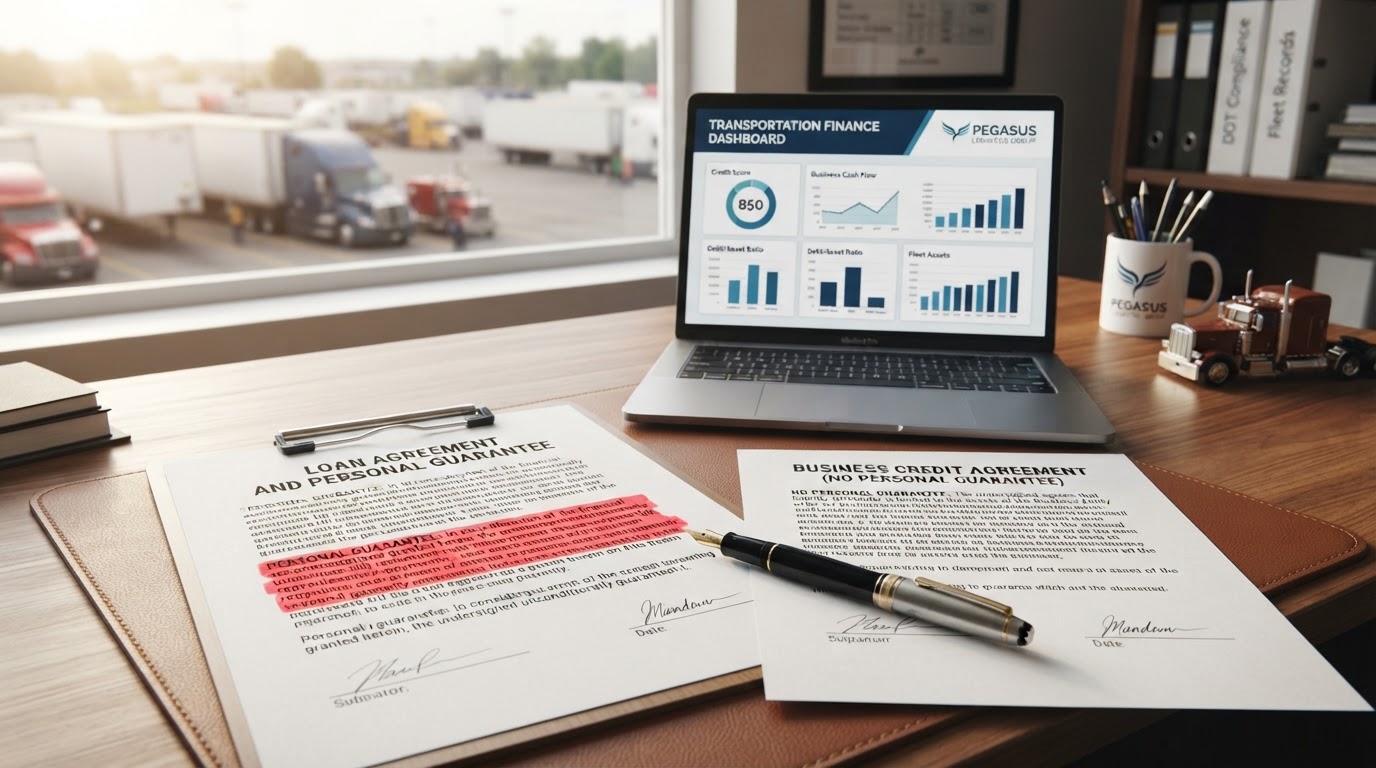
Damon Boswell has watched too many truckers sign away the one thing they spent years protecting, and they do it in the span of thirty seconds. The trucker is at the parts counter or on the phone with a card issuer, the rep slides over a one-page agreement, points to a line near the bottom, and says sign here. The trucker signs, the card funds, the truck rolls, and nobody mentions that the signature just tied the owner's house, savings, and personal credit to a business debt the LLC was supposed to absorb. Ashley Boswell calls it the thirty-second mistake, because the guarantee clause is the single most expensive line a trucker ever signs, and it is the line almost nobody reads.
In this guide, Damon Boswell and Ashley Boswell break down what a personal guarantee actually is and how it works in 2026, how it pierces the corporate veil a trucker paid to build, why a no-personal-guarantee product protects the owner's home, savings, and personal credit score, how a strong business credit file is the exact thing that unlocks the no-PG option, and how the Blueprint system builds the file that lets a trucker say no to the guarantee instead of being forced to sign it. Because the trucker who understands the guarantee is the trucker who never has to rely on one.
The Core Principle
A personal guarantee is a legal promise that the owner will personally repay a business debt if the business cannot, which means the lender can pursue the owner's personal bank accounts, property, and personal credit to recover what the business owes. A no-personal-guarantee product is underwritten against the business's own credit file and revenue, so the business, not the owner, carries the risk. Damon Boswell and Ashley Boswell's rule: the LLC is the shield, and a personal guarantee is a hole drilled through it, so build the file that lets you take the product without drilling the hole.
What a Personal Guarantee Actually Is
Ashley Boswell defines the personal guarantee precisely, because the definition is where the danger lives. A personal guarantee is a written, legally binding commitment in which a business owner agrees to be personally responsible for repaying a business obligation if the company defaults. When a trucker signs a personal guarantee on a fuel card, a business credit card, an equipment loan, or a working capital line, the trucker is effectively co-signing the business debt, which gives the lender the right to go after the owner's personal assets, savings accounts, real estate equity, and in some cases personal retirement holdings, to satisfy a balance the business failed to pay.
Damon Boswell explains why the guarantee is so common in trucking specifically. Most trucking companies are small businesses with thin or nonexistent business credit files, which means the lender has no business-side credit history to underwrite against. To protect itself, the lender requires the owner's personal guarantee as a backstop, and because the trucker needs the funding today, the trucker signs. The guarantee is the lender's answer to a missing business credit file, which is exactly why building the file is the trucker's answer to the guarantee. The stronger the business file, the less the lender needs the owner's signature, and the less the owner's personal assets sit on the line.
- A personal guarantee makes the owner personally liable for business debt if the business defaults.
- The lender can pursue the owner's personal bank accounts, property equity, and personal credit.
- Late payments on a guaranteed account can report to and damage the owner's personal credit score.
- Guarantees are common because lenders want protection when the business credit file is thin.
- The guarantee is the lender's answer to a missing business file, so building the file is the trucker's answer to the guarantee.
How a Guarantee Pierces the Corporate Veil
Damon Boswell walks through the legal separation the trucker paid to create and how the guarantee undoes it. When a trucker forms an LLC or a corporation, the entity creates a legal boundary between the business's liabilities and the owner's personal assets, the boundary commonly called the corporate veil. If the business is sued or defaults on a debt, the veil is what keeps the creditor from reaching the owner's house and savings. A personal guarantee is a voluntary, contractual hole drilled through that veil, because by signing it the owner agrees that, for this specific debt, the owner will personally stand behind the obligation regardless of the entity. The veil still exists for other liabilities, but for the guaranteed debt, the owner has personally opened the door.
Ashley Boswell adds the personal credit dimension, which is the part most truckers underestimate. A business credit card or fuel card with a personal guarantee often reports the payment history to the owner's personal credit file, not just the business file, which means a late payment or a high balance on the business card can drop the owner's personal credit score and raise the cost of the owner's personal mortgage, auto loan, or insurance. The guarantee does not just expose the owner's assets, it exposes the owner's personal credit, which is the score the owner relies on for everything outside the business. A trucker who guarantees five business cards has tied five business balances to one personal score.
You paid to build the wall, and then you signed the paper that knocks a hole in it. Build the file instead, and leave the wall standing.
The Boswell Veil Rule
Damon Boswell and Ashley Boswell tell every client: the LLC is the shield, and every personal guarantee is a hole in it. A no-PG product keeps the shield intact for the debt it covers, protects the owner's personal credit from business reporting, and leaves the owner's house and savings out of the business's risk. The file you build is what lets you take the product without drilling the hole.
What a No-Personal-Guarantee Product Actually Does
Ashley Boswell defines the no-PG product by contrast. A no-personal-guarantee fuel card, business credit card, equipment loan, or working capital line is underwritten against the business's own credit file, its D-U-N-S history, its PAYDEX, its tradeline aging, and the consistency of its business deposits, rather than the owner's personal credit and signature. Because the lender relies on the business file, the owner does not sign a personal guarantee, which means a default on that specific product does not give the lender a direct claim against the owner's personal assets, and the payment history reports to the business credit bureaus rather than the owner's personal file. The business carries the debt, and the owner's personal credit and assets stay out of it.
Damon Boswell is clear about the tradeoff, because no-PG products are not free. Because the lender takes on more risk without the owner's backstop, no-PG products often carry slightly higher rates, smaller initial limits, or stricter business-file requirements than their guaranteed counterparts, and they are only available to a business with a built, reporting credit file. A trucker with a thin file cannot reach a no-PG product at all, which is why the no-PG option is not a switch the trucker flips, it is a door the trucker builds the file to unlock. The file is the price of admission, and the protection of the owner's personal assets is the reward.
- A no-PG product is underwritten on the business credit file and deposits, not the owner's signature.
- Default on a no-PG product does not give the lender a direct claim against the owner's personal assets.
- Payment history reports to the business bureaus, not the owner's personal credit file.
- No-PG products may carry slightly higher rates or smaller initial limits as the lender's risk premium.
- No-PG products are only reachable by a business with a built, reporting credit file.
How the Business Credit File Unlocks the No-PG Option
Damon Boswell explains the underwriting logic that connects the file to the no-PG product. A lender offering a no-PG card or loan needs evidence that the business can service the debt on its own, and that evidence is the business credit file. A PAYDEX of 80 tells the lender the business pays its trade accounts on time. A diversified tradeline mix, a net-30 vendor, a revolving card, and a reporting fuel card, tells the lender the business manages multiple credit types responsibly. Tradeline aging tells the lender the business has a track record, not a brand-new file. A clean three-bureau report tells the lender the file is accurate and free of disputes. Each piece of the file is a data point the lender uses to underwrite without the owner's guarantee, which is why a trucker who builds the file earns the right to say no to the signature.
Ashley Boswell notes that the no-PG market in trucking has grown precisely because the business credit bureaus now provide the data lenders need to underwrite on the business alone. Reporting fuel cards, net-30 vendor accounts, and business credit cards that report to Dun & Bradstreet, Experian Business, and Equifax Small Business give lenders a real-time picture of the business's payment behavior, which lets a lender confidently extend credit without the owner's personal backstop. A trucker who builds and maintains that file is building the exact asset the no-PG lender is reading, which is why the build is not optional, it is the prerequisite to every no-PG product the trucker will ever apply for.
When a Guarantee Is and Is Not Avoidable
Ashley Boswell is honest that not every product can be had without a guarantee, and a trucker should know where the line is. Net-30 vendor accounts and reporting fuel cards are the products most commonly available without a personal guarantee, because they are underwritten on the business file and the vendor's own risk tolerance for trade credit. No-PG business credit cards and working capital lines are available to a business with a mature, diversified file and steady deposits. Larger equipment financing and SBA-style loans, by contrast, often still require a personal guarantee even for a strong business, because the dollar amounts and the lender's risk model demand it. The goal is not to eliminate every guarantee, it is to eliminate the guarantees on the everyday operating products, fuel, cards, and working capital, that a built file can carry on its own.
Damon Boswell frames the strategy. The trucker who builds the file converts the everyday operating debt, the fuel card, the business credit card, the working capital line, from personally guaranteed to no-PG, which removes the owner's personal credit and assets from the day-to-day risk of running the trucks. The larger, occasional debt, a big equipment loan, may still carry a guarantee, but it is a single, deliberate, well-understood obligation rather than a dozen guaranteed cards quietly dragging on the owner's personal credit. The file does not have to eliminate every guarantee to protect the owner, it has to eliminate the everyday ones that compound the personal exposure.
The Boswell Strategy Rule
Damon Boswell and Ashley Boswell's strategy: build the file to convert the everyday operating products, fuel cards, business credit cards, and working capital, to no-PG, and accept a guarantee only on the rare, large obligation the file cannot yet carry alone. The goal is not zero guarantees, it is zero guarantees on the debt that runs the trucks every day.
How the No-PG Build Fits the 3-Step Blueprint
Damon Boswell and Ashley Boswell build the file that lets a trucker reach the no-PG products and decline the guarantee, through the same three steps.
Step 1 — Compliance & Foundation Audit
Ashley Boswell confirms the entity, EIN, dedicated business bank account, listed phone, and D-U-N-S Number, the foundation a no-PG lender verifies before underwriting on the business alone. A business that is not properly separated and verified cannot be underwritten without the owner's guarantee, so the foundation is the first thing the no-PG lender checks.
Step 2 — Build Reporting Trade Lines
Damon Boswell opens the three-type mix of net-30 vendor, revolving business credit card, and reporting fuel card, each verified to report to the business bureaus, and guides the early-payment, low-utilization discipline that builds the PAYDEX and aging a no-PG lender underwrites against. The file that reads as low risk is the file that earns the no-PG product.
Step 3 — Unlock No-PG Fleet Capital
With a mature, diversified, low-utilization three-bureau file, Damon Boswell and Ashley Boswell unlock the no-PG fuel cards, business credit cards, and working capital lines the trucking company qualified for, each without a personal guarantee, so the owner's house, savings, and personal credit stay out of the everyday operating debt the business carries on its own EIN.
Common Guarantee Mistakes to Avoid
- Signing a personal guarantee without reading the clause because the funding is needed today.
- Guaranteeing everyday operating products, fuel and cards, that a built file could carry on its own.
- Assuming the LLC alone protects personal assets when the guarantee contractually pierces the veil.
- Letting guaranteed business cards report to personal credit and dragging down the owner's personal score.
- Stacking multiple guaranteed cards so one slow month threatens the owner's personal credit across all of them.
- Waiting until the cash crunch to build the file, when the no-PG option needs months of history.
- Believing no-PG products are free, when they carry stricter file requirements and sometimes higher rates.
- Treating the guarantee as a one-time formality rather than a recurring exposure that compounds with every signed account.
The Bottom Line from Damon & Ashley
A personal guarantee is a legal promise that the owner will personally repay a business debt if the business cannot, and it pierces the corporate veil the trucker paid to build by giving the lender a direct claim against the owner's personal assets and personal credit. A no-personal-guarantee product is underwritten against the business's own credit file and revenue, so the business carries the debt and the owner's house, savings, and personal credit stay out of it, but the no-PG option is only reachable by a business with a built, reporting, three-bureau credit file. Damon Boswell and Ashley Boswell built the Blueprint system to build that file, so the trucker can convert the everyday operating products, the fuel cards, the business credit cards, and the working capital lines, from personally guaranteed to no-PG, and leave the owner's personal assets out of the day-to-day risk of running the trucks.
If you are signing personal guarantees on fuel cards or business credit cards and want to know whether your file can carry them on its own, or if you want to build the file that lets you decline the guarantee on your next application, Damon Boswell and Ashley Boswell can audit your three-bureau reports, map the gap between your current file and a no-PG profile, and show you exactly how to build the file that protects your personal assets. Request a three-bureau credit audit and find out where your file stands today.