
Hard vs. Soft Inquiries: How Credit Pulls Quietly Damage a Trucking Business Credit File in 2026
Every time a trucker applies for a fuel card, a loan, or a vendor account, a credit pull can ding the business file—and most owners never know which pulls hurt and which don't. Damon Boswell and Ashley Boswell break down the difference between hard and soft inquiries, how each of the three business bureaus tracks them, how long the impact lasts, and how to apply for no-PG capital without stacking inquiries that sink the file.
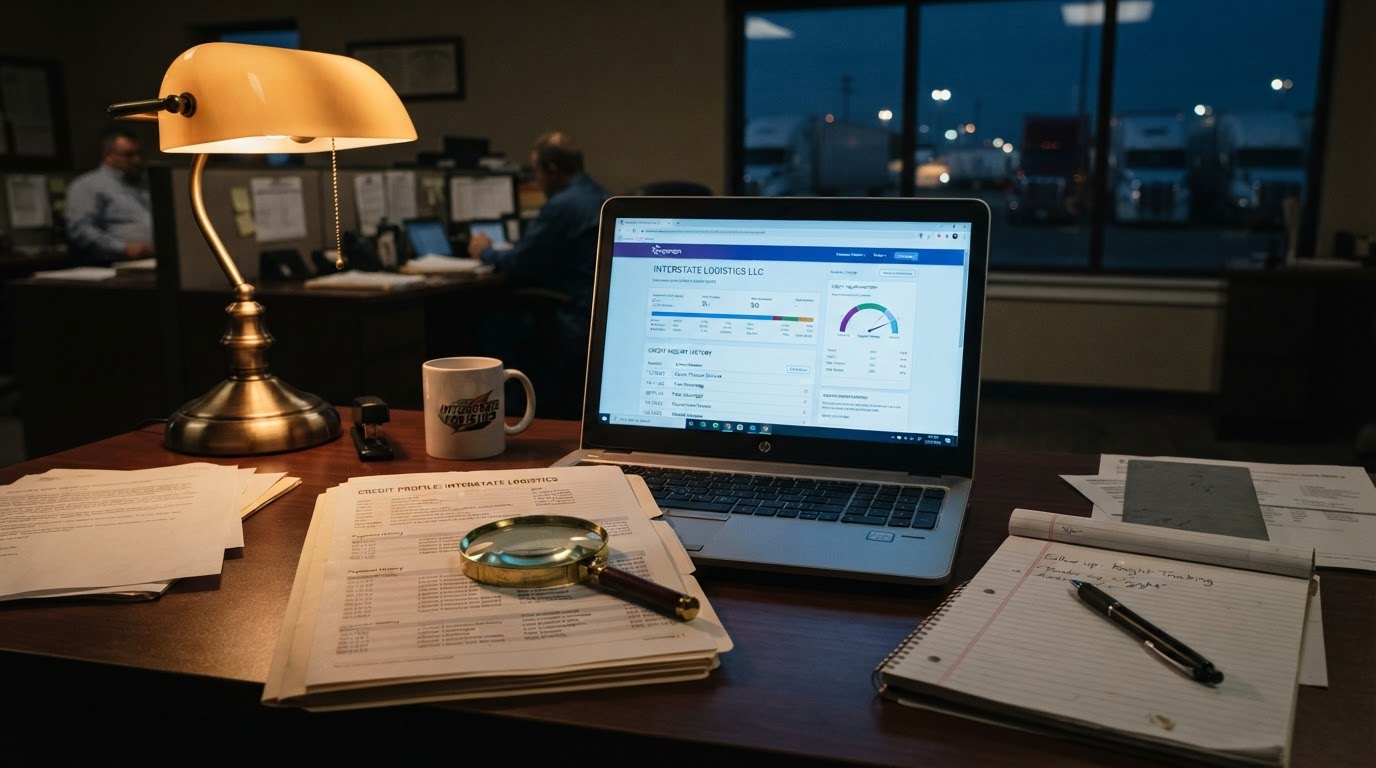
Damon Boswell reviews a declined no-PG fuel card application and almost always finds the same culprit buried in the business credit report: a stack of hard inquiries from the last nine months. The trucker applied for a fuel card, got declined, applied for a loan, got declined, applied for a vendor account, applied for a working-capital line—each one a formal application, each one a hard pull, each one a small ding that compounded into a risk signal. The trucker never knew the applications were hurting the very file they were trying to build. Ashley Boswell calls it the inquiry spiral, and it is one of the most preventable reasons a trucking company gets declined for capital it otherwise deserves.
In this guide, Damon Boswell and Ashley Boswell break down the difference between hard and soft credit inquiries, how each of the three business bureaus tracks them and for how long, how a stack of hard pulls signals risk to a lender, and how the Blueprint system sequences applications so a trucker applies for no-PG capital without stacking inquiries that sink the file. Because the trucker who controls the pulls controls the outcome.
The Core Principle
A hard inquiry happens only when you formally apply for credit, and it can temporarily lower your business credit score. A soft inquiry does not affect the score at all. Damon Boswell and Ashley Boswell's rule: never apply blind—confirm a strong chance of approval before every hard pull, and use soft-pull or no-credit-check options to build the file without adding inquiries.
Hard Inquiries Explained
Ashley Boswell defines a hard inquiry: it occurs when a business formally applies for credit—a fuel card, an equipment loan, a business credit card, a working-capital line, or supplier trade credit—and the lender pulls the business credit report as part of the underwriting decision. The pull requires the applicant's permission, and it signals to the bureaus that the business is seeking credit, which makes the business slightly riskier to lend to in the eyes of future lenders. That is why a hard inquiry can temporarily lower a business credit score, and why a stack of them in a short window reads as desperation.
Damon Boswell stresses that hard inquiries are not inherently bad—they are a normal and necessary part of getting credit to grow the business. The problem is when they pop up unexpectedly or pile up from applications that were never likely to be approved. A trucker who applies for five products in a month, gets declined on four, and lands one has added five hard inquiries to the file for a single approval. The next lender sees the four declines as much as the one approval, and the file reads as higher risk than it actually is.
- A hard inquiry happens only with a formal application for credit.
- It requires the applicant's permission.
- It can temporarily lower the business credit score.
- Multiple hard inquiries in a short window signal risk to lenders.
- Hard inquiries are a normal part of growth—stacking them is the problem.
Soft Inquiries Explained
Damon Boswell contrasts the hard pull with the soft inquiry. A soft inquiry does not affect the business credit score at all, regardless of how many occur. Soft inquiries happen for pre-approvals, promotional offers, when a business checks its own credit report, or when a potential investor or partner reviews the file. Unlike personal credit reports, anyone can check a business credit report without the business's permission, but those third-party checks are soft inquiries with no scoring impact. The key distinction is that a soft pull is never tied to a formal application for a specific amount of credit.
Ashley Boswell notes that some business credit cards and vendor accounts are available with a soft pull or no credit check at all, which makes them ideal first tradelines for a trucker building a file without adding hard inquiries. The trade-off is that the trucker must confirm whether the account reports to the bureaus, because a tradeline that does not report builds no credit even if it avoids the inquiry. The Blueprint system uses soft-pull and no-check accounts early in the build precisely to add reporting tradelines without stacking hard pulls.
A hard pull is the cost of applying. A soft pull is free. The trucker who knows the difference builds a file without paying the inquiry tax on every application.
How Each Bureau Tracks Inquiries
Ashley Boswell walks through how the three business bureaus track hard inquiries, because the timelines differ and a trucker needs to know how long each pull lingers. Experian tracks credit applications within roughly the last nine months. Dun & Bradstreet tracks inquiries for about twelve months. Equifax tracks hard inquiries for up to two years. The scoring impact of each pull is temporary and diminishes over time, but the inquiry remains visible on the report for the full tracking window, which means a lender pulling the file can see the history even after the score impact has faded.
Damon Boswell translates this into a practical rule: space applications so that older inquiries drop off before new ones are added, and never apply for several products in the same month unless the build is ready for it. A trucker who plans applications around the bureau tracking windows keeps the inquiry count low and the file reading as stable rather than credit-hungry.
- Experian — tracks hard inquiries within roughly the last 9 months.
- Dun & Bradstreet — tracks inquiries for about 12 months.
- Equifax — tracks hard inquiries for up to 2 years.
- Score impact is temporary and diminishes over time.
- The inquiry stays visible on the report for the full tracking window.
The Boswell Inquiry Rule
Damon Boswell and Ashley Boswell tell every client: before any hard pull, ask the lender whether a soft pull or pre-qualification is available, confirm a strong chance of approval, and never apply for more than one hard-pull product in the same month. Build the file with soft-pull and no-check tradelines first, then apply for hard-pull capital only when the file is ready to approve.
How Inquiries Fit the 3-Step Blueprint
Damon Boswell and Ashley Boswell sequence applications deliberately through the three steps to minimize hard pulls and maximize approvals.
Step 1 — Compliance & Foundation Audit
Ashley Boswell confirms the entity, EIN, and D-U-N-S Number, and pulls the baseline three-bureau reports—soft pulls that cost nothing—to see the current inquiry history. Any stacked inquiries are mapped, and a plan is set to let the oldest ones drop before new applications begin.
Step 2 — Build Reporting Trade Lines
Damon Boswell opens the first tradelines using soft-pull or no-credit-check vendor and card accounts wherever possible, adding reporting history without adding hard inquiries. Where a hard pull is unavoidable, applications are spaced so the file never shows a cluster.
Step 3 — Unlock No-PG Fleet Capital
With a mature, low-inquiry file, Damon Boswell and Ashley Boswell apply for the no-PG fuel cards, equipment financing, and working capital the trucking company qualified for—each application made only when the file is ready to approve, so the hard pull is the last one, not the first of many.
Common Inquiry Mistakes to Avoid
- Applying for multiple credit products in the same month and stacking hard pulls.
- Applying blind without confirming a strong chance of approval first.
- Ignoring whether a vendor or card uses a soft pull or a hard pull.
- Opening tradelines that do not report, adding inquiries for no credit benefit.
- Failing to monitor the inquiry history on all three bureau reports.
- Re-applying immediately after a decline, which adds another hard pull to a flagged file.
- Not asking a lender for a soft pre-qualification before a formal application.
The Bottom Line from Damon & Ashley
Hard inquiries are a normal cost of applying for credit, but a stack of them is one of the most preventable reasons a trucking business credit file reads as risky. A trucker who knows the difference between a hard and a soft pull, who spaces applications around the bureau tracking windows, and who builds the file with soft-pull and no-check tradelines first can apply for no-PG capital without paying the inquiry tax on every application. Damon Boswell and Ashley Boswell built the Blueprint system to sequence applications exactly that way—so the hard pull that unlocks the capital is the one that approves, not the fifth one that declines.
If your file is carrying a stack of hard inquiries, or if you have been declined and are unsure whether to reapply, Damon Boswell and Ashley Boswell can pull your three-bureau reports, map your inquiry history, and show you exactly when and how to apply for no-PG capital without sinking the file. Request a three-bureau credit audit and find out where your inquiry history stands today.