
Disputing Errors on a Business Credit Report: How a Trucker Fixes a File a Lender Misreads in 2026
A single reporting error on a business credit report can sink a no-PG application that should have approved, and most truckers never know the file is wrong until the decline letter arrives. Damon Boswell and Ashley Boswell break down the most common errors that appear on a trucking business credit report, how to pull all three bureau reports, how to dispute inaccurate tradelines and firmographic data under the FCRA and each bureau's process, the 30-day investigation timeline, and how the Blueprint system audits and corrects a file before a single no-PG application is filed.
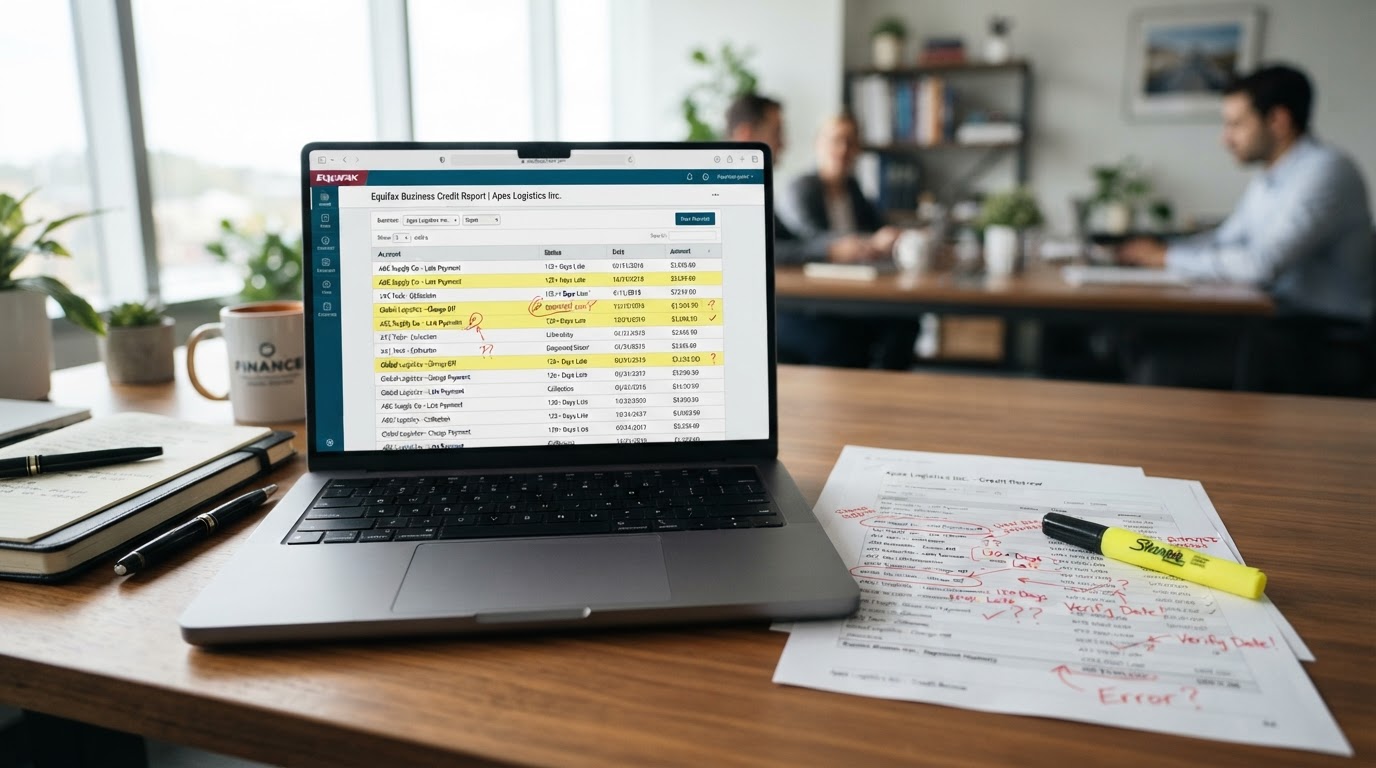
Damon Boswell has opened enough declined no-PG applications to know the cruelest reason for a rejection: the file was wrong. The trucker paid every account on time, built the tradelines right, kept utilization low, and still got declined because a vendor reported a late payment that never happened, a closed account showed as open and maxed, or the business name and address mismatched across bureaus so the lender's underwriter could not confirm the entity was real. The trucker did everything right and lost the approval to a data error they never knew existed. Ashley Boswell calls it the silent decline, because the business earned the capital and a reporting mistake took it away.
In this guide, Damon Boswell and Ashley Boswell break down the most common errors that appear on a trucking business credit report in 2026, how to pull all three bureau reports to find them, how to dispute inaccurate tradelines and firmographic data under the Fair Credit Reporting Act and each bureau's own process, the thirty-day investigation timeline and what to do when a bureau does not respond, and how the Blueprint system audits and corrects a file before a single no-PG application is filed. Because the trucker who fixes the file before the lender sees it is the trucker whose application approves.
The Core Principle
A business credit report is only as accurate as the data the bureaus receive, and the data is often wrong. Under the FCRA, a business has the right to dispute any inaccurate, incomplete, or unverifiable information, and the bureau must investigate within roughly thirty days. Damon Boswell and Ashley Boswell's rule: never apply for no-PG capital on a file you have not audited, because an uncorrected error is the most preventable reason for a decline.
The Most Common Report Errors
Ashley Boswell catalogs the errors that show up most often on a trucking business credit report. The first is the phantom late payment, where a vendor reports a payment as thirty or sixty days late when the trucker paid on time, often because the vendor's billing system lagged or the payment posted after the reporting cycle closed. The second is the ghost account, a tradeline that was closed but still reports as open and carrying a balance, which inflates utilization and makes the file look stretched. The third is duplicate reporting, where the same debt appears twice, once under the vendor and once under a financing partner, which doubles the apparent liability.
Damon Boswell adds the firmographic errors, which are the data-point mistakes that undermine the entity's credibility. A wrong business name, a mismatched address between the bureau and the state filing, a stale phone number, or an incorrect industry classification can make a lender's underwriter read the business as unverifiable, because the firmographic data is how the lender confirms the entity is real and stable. A trucker whose D-U-N-S profile shows a residential address while the state filing shows a different operating address presents a mismatch that a cautious underwriter flags as a verification risk. None of these errors reflect the business's actual creditworthiness, but each one can sink an application that should have approved.
- Phantom late payment — a vendor reports a payment as late when it was made on time.
- Ghost account — a closed tradeline still reports as open with a balance, inflating utilization.
- Duplicate reporting — the same debt appears twice, doubling the apparent liability.
- Firmographic mismatch — wrong business name, address, phone, or industry classification.
- A single uncorrected error can decline a no-PG application the business otherwise earned.
Pulling All Three Bureau Reports
Damon Boswell explains why pulling all three bureaus is non-negotiable before a dispute, because each bureau collects and reports data independently and an error on one does not appear on the others. Dun & Bradstreet, Experian Business, and Equifax Small Business each maintain separate business credit files, and a vendor may report to one, two, or all three, which means the same phantom late payment can sit on the Experian file while the D&B file is clean. A trucker who pulls only one bureau and disputes the error there may still get declined because the lender pulled a different bureau where the error persisted. The Blueprint system pulls all three before any application, because a clean file has to be clean everywhere a lender might look.
Ashley Boswell notes that each bureau offers a way to access the business credit report directly, either through a paid monitoring service or a one-time report pull, and that a trucker building a no-PG file should treat the three-bureau pull as a recurring audit rather than a one-time check. Errors can appear at any cycle as vendors update their reporting, so the file that was clean in March can carry a phantom late payment by June if a vendor's system misfires. Regular monitoring catches the error before the lender does.
How to Dispute Under the FCRA
Damon Boswell walks through the dispute process the Fair Credit Reporting Act gives every business. When a trucker identifies inaccurate, incomplete, or unverifiable information on a business credit report, the business has the right to dispute it directly with the bureau that is reporting it. The dispute is filed in writing, through the bureau's online dispute portal or by mail, and it must identify the specific information being disputed, explain why it is inaccurate, and include any supporting documentation, such as payment confirmations, account statements, or the closure letter for a ghost account. The bureau is then required to investigate the disputed item.
Ashley Boswell explains the timeline the FCRA sets. Once a bureau receives a dispute, it must investigate and resolve it, generally within thirty days, and it must notify the business of the results in writing. If the investigation confirms the information is inaccurate or cannot be verified, the bureau must correct or delete it from the report. If the information is verified as accurate, it stays. The trucker can also dispute directly with the furnisher, the vendor or lender that reported the data, because the FCRA requires furnishers to investigate disputes and correct inaccurate reporting as well. Filing with both the bureau and the furnisher is the strongest approach, because it attacks the error from both ends.
The Boswell Dispute Rule
Damon Boswell and Ashley Boswell tell every client: dispute in writing, identify the specific error, attach the proof, and file with both the bureau and the furnisher. If the bureau does not resolve the dispute within thirty days, follow up in writing and request that the unverified item be deleted. An uninvestigated error does not get to stay on the file just because the bureau was slow.
The Thirty-Day Investigation Timeline
Damon Boswell emphasizes the timing discipline that makes disputes work. Because the FCRA gives the bureau roughly thirty days to investigate, a trucker who finds an error should file the dispute immediately and track the date, so that if the thirty-day window passes without a resolution, the follow-up is filed the day after. The bureau is required to delete information it cannot verify within the investigation window, which means a slow or non-responsive bureau does not get to keep a disputed tradeline on the file indefinitely. The trucker who tracks the dates controls the outcome, because the law puts the burden of verification on the bureau, not the business.
Ashley Boswell adds the practical sequencing. Because a dispute can take thirty days to resolve, and because a no-PG application should never be filed on a file that still carries a disputed error, the dispute has to be timed before the application cycle, not during it. A trucker who finds an error two weeks before a planned application should delay the application to let the dispute resolve, because a lender pulling a file mid-dispute sees the error and the dispute flag simultaneously, which can read as an unresolved risk. The Blueprint system audits the file, files disputes, and waits for resolution before any application goes out, so the lender never sees a file that is still under construction.
A no-PG lender reads the file as it stands the day it pulls it. Dispute the error, wait for the resolution, and only then apply. A file still under construction is a file still getting declined.
Disputing Firmographic Data
Ashley Boswell addresses the firmographic disputes separately, because they follow a slightly different path. A business name, address, phone, or industry classification error is often corrected through the bureau's business profile update process rather than the tradeline dispute process. Dun & Bradstreet allows a business to claim and update its own D-U-N-S profile, which is the fastest way to correct a mismatched address or stale phone number. Experian and Equifax similarly allow business profile updates. The trucker should ensure the firmographic data on all three bureau profiles matches the state filing, the EIN record, and the 411 listing, because consistency across every public record is what makes the entity verifiable to a lender's underwriter.
Damon Boswell notes that a D-U-N-S profile update is also where a trucker corrects an incorrect industry classification, which matters more than most owner-operators realize. A business classified in the wrong industry can be read as a different risk profile than the trucking company actually carries, and some lenders underwrite partly on industry codes. A trucking company misclassified as a generic freight handler when it is a specialized carrier, or vice versa, presents a mismatch that a careful underwriter flags. The profile update is a small fix with a real underwriting impact.
How Disputes Fit the 3-Step Blueprint
Damon Boswell and Ashley Boswell treat the audit-and-dispute step as the gate before every no-PG application, because a clean file is the prerequisite to a fundable one.
Step 1 — Compliance & Foundation Audit
Ashley Boswell confirms the entity, EIN, and D-U-N-S Number, then pulls all three bureau reports and audits every tradeline, every firmographic data point, and every inquiry for accuracy. Any error is identified, documented, and disputed with both the bureau and the furnisher, and the file is not advanced until the disputes resolve.
Step 2 — Build Reporting Trade Lines
Damon Boswell opens the three-type mix of net-30 vendor, revolving card, and reporting fuel card on a clean, audited file, monitoring each cycle for reporting accuracy and disputing any vendor error the moment it appears. A clean build is only clean if every cycle's reporting is verified, not assumed.
Step 3 — Unlock No-PG Fleet Capital
With a fully audited, dispute-resolved, and clean three-bureau file, Damon Boswell and Ashley Boswell apply for the no-PG fuel cards, equipment financing, and working capital the trucking company qualified for. The lender pulls a file that is accurate, verified, and free of the errors that would otherwise decline an approval the business earned.
Common Dispute Mistakes to Avoid
- Applying for no-PG capital without auditing all three bureau reports first.
- Pulling only one bureau and missing an error that sits on the other two.
- Filing a dispute without attaching the payment confirmation or closure documentation.
- Disputing with the bureau only and not the furnisher that reported the bad data.
- Filing a no-PG application while a dispute is still open and unresolved.
- Ignoring firmographic mismatches that make the entity read as unverifiable.
- Failing to follow up after thirty days when a bureau does not resolve the dispute.
- Assuming the file is accurate because the payments are accurate, when the reporting can still be wrong.
The Bottom Line from Damon & Ashley
A business credit report is only as accurate as the data the bureaus receive, and the data is wrong often enough that an uncorrected error is one of the most preventable reasons a trucking company gets declined for no-PG capital it otherwise earned. A phantom late payment, a ghost account, a duplicate tradeline, or a firmographic mismatch can sink an application that should have approved, and the only defense is a three-bureau audit, a documented dispute under the FCRA, and the discipline to wait for the resolution before the application is filed. Damon Boswell and Ashley Boswell built the Blueprint system to audit and correct the file before a single no-PG application goes out, so the lender pulls a file that is accurate, verified, and clean, which is the exact file that earns the approval the business deserves.
If you have been declined and you suspect a reporting error, or if you want to audit your file before your next no-PG application, Damon Boswell and Ashley Boswell can pull your three-bureau reports, identify every error and firmographic mismatch, file the disputes with the bureaus and furnishers, and show you exactly what to correct before you apply. Request a three-bureau credit audit and find out where your file stands today.