
Business Line of Credit for Trucking Companies: The No-PG Revolving Capital Guide for 2026
A business line of credit is the revolving safety net a trucking company draws on when a broker pays slow, a repair bill lands, or fuel prices spike—but most lines demand a personal guarantee that puts the owner's house on the line. Damon Boswell and Ashley Boswell break down how a business line of credit actually works, secured versus unsecured, why a no-PG line demands a thick three-bureau file, and how to qualify for $50,000 to $250,000 of revolving capital without a personal guarantee in 2026.
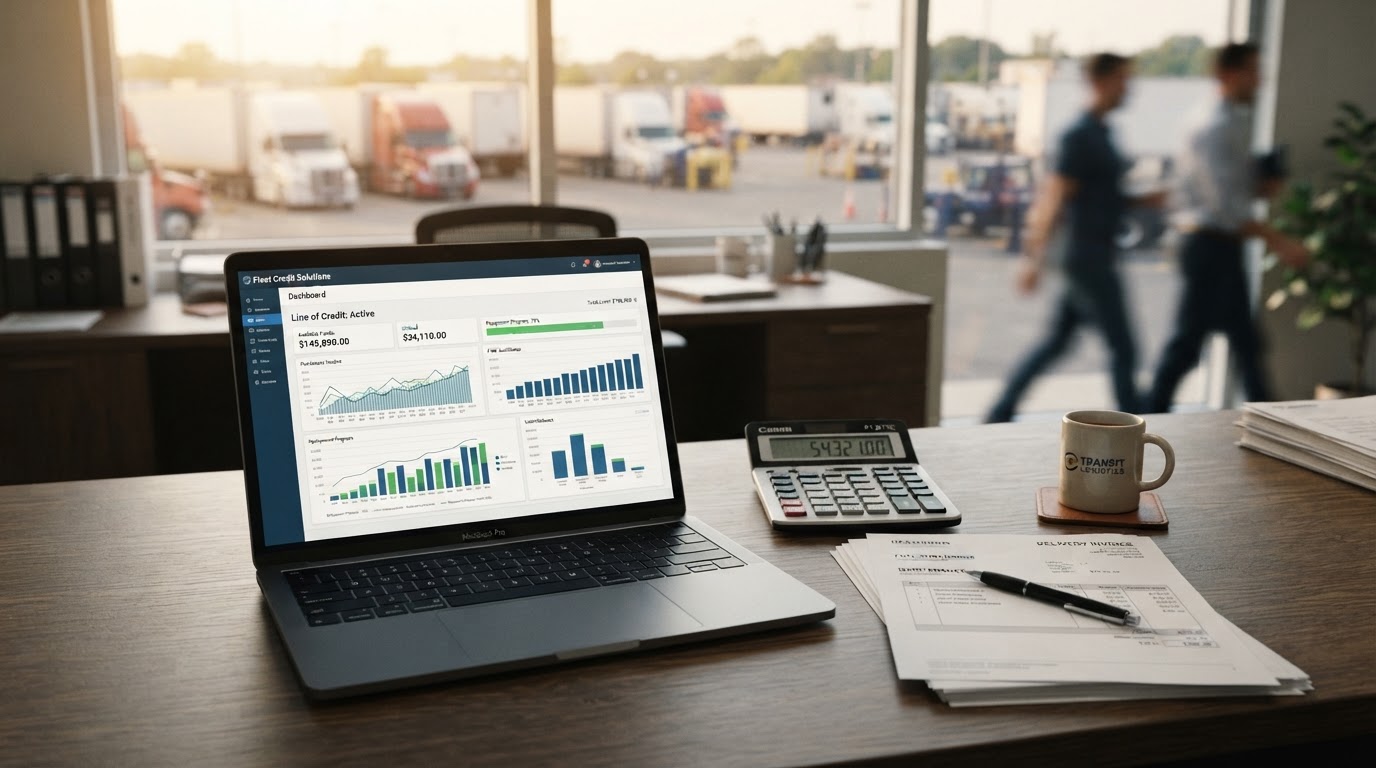
Ashley Boswell draws a single diagram for every trucking client who asks about a business line of credit: a circle with a gap. The circle represents the revolving nature of the line—draw, repay, draw again—and the gap represents the cash-flow shortfall a line of credit is designed to bridge. A broker pays in 45 days but the driver needs fuel today; a trailer repair costs $8,000 and the factoring advance only covers 90 percent; a fuel surcharge lags a month behind the pump price. These are the gaps a line of credit fills, and unlike a term loan, the line only charges interest on what is drawn. The problem Damon Boswell and Ashley Boswell see every week is that most lines of credit come with a personal guarantee—a clause that puts the owner's house, savings, and personal credit on the line if the business defaults. The trucker who signs it rarely reads it, and the line that was supposed to protect the business ends up threatening the family.
In this guide, Damon Boswell and Ashley Boswell break down what a business line of credit actually is, how it differs from a term loan and a credit card, the difference between a secured and an unsecured line, why a no-PG line demands a thicker business credit file than almost any other product, what the typical terms and limits look like in 2026, and how the Blueprint system builds the three-bureau profile that qualifies a trucking company for a $50,000 to $250,000 revolving line without a personal guarantee. Because the line of credit that protects the business should not be the line that risks the owner.
The Core Principle
A business line of credit is a safety net, not a windfall. Damon Boswell and Ashley Boswell's rule: a line of credit is revolving capital you draw only when a cash-flow gap opens, and you repay the moment the gap closes. A no-PG line is available to a trucking company only when the business credit file is thick enough to stand on its own—because the lender is lending to the business, not the owner.
What a Business Line of Credit Actually Is
Damon Boswell starts with the definition. A business line of credit is a flexible, revolving pool of capital that a lender extends to a business up to a set credit limit. The business can draw any amount up to the limit at any time, and it pays interest only on the amount drawn, not on the full limit. As the business repays what it has drawn, that portion of the line becomes available to draw again—hence revolving. This differs fundamentally from a term loan, which disburses a lump sum upfront and requires fixed monthly payments of principal and interest regardless of whether the funds are being used. A line of credit is also distinct from a business credit card, which is a specific type of revolving credit designed for point-of-sale transactions and often carrying higher interest rates.
Ashley Boswell explains the trucking-specific value. A trucking company's cash flow is inherently lumpy: a broker may pay a freight invoice in 30, 45, or 60 days, while the carrier pays for fuel, driver pay, and maintenance weekly. A line of credit smooths that mismatch by giving the business a pool to draw from when the outflows outrun the inflows, and to repay when the invoices land. The line is not meant to fund a permanent expansion—that is what a term loan or equipment financing is for—it is meant to bridge the timing gaps that every trucking company faces. Used correctly, it is the most efficient form of short-term working capital available.
- Revolving capital — draw up to a limit, repay, and draw again.
- Interest accrues only on the drawn balance, not the full limit.
- Differs from a term loan, which disburses a lump sum with fixed payments.
- Differs from a credit card, which is point-of-sale revolving credit with higher rates.
- Ideal for cash-flow timing gaps, not permanent expansion.
Secured vs. Unsecured Lines
Damon Boswell draws the critical distinction that determines whether a personal guarantee is on the table. A secured line of credit is backed by collateral—typically accounts receivable, equipment, or inventory—that the lender can claim if the business defaults. Because the lender carries less risk on a secured line, it is more likely to offer a higher limit, a lower rate, and, in some cases, a reduced or waived personal guarantee. An unsecured line of credit requires no collateral, which means the lender's only recourse in a default is the business's assets and the personal guarantee if one is attached. Unsecured lines are faster to open and simpler to manage, but they almost always require a personal guarantee unless the business credit file is strong enough to replace the collateral as the lender's security.
Ashley Boswell connects this directly to the no-PG goal. The reason most unsecured lines demand a personal guarantee is that the lender has nothing else to fall back on; the business credit file is the lender's only signal of risk. A trucking company with a thin file looks like a blank slate, so the lender demands the owner's personal guarantee as its security. A trucking company with a thick three-bureau file—a PAYDEX of 80 or above, an Intelliscore in the low-risk band, and an Equifax Payment Index at 90—gives the lender a clear, low-risk signal that can replace the personal guarantee. That is the entire premise of the no-PG line: a strong enough business file that the lender underwrites the business, not the owner.
A lender asks for a personal guarantee for one reason: it doesn't trust the business yet. Build the file the lender trusts, and the guarantee becomes optional. That's not a sales pitch—that's how underwriting actually works.
Why a No-PG Line Demands a Thicker File
Damon Boswell is blunt about the standard. A no-PG business line of credit is one of the hardest products to qualify for, because the lender is taking on unsecured risk with no personal backstop. To offset that risk, the lender compensates with stricter requirements: a strong, mature business credit profile across all three bureaus, significant and consistent revenue, and a longer time in business. Most lenders that waive the personal guarantee want to see two or more years in business, annual revenue that supports the limit requested, and a business credit file that demonstrates a consistent, on-time payment history. A trucking company that meets those standards can access a line that protects the business without risking the owner's personal assets.
Ashley Boswell adds the nuance the industry rarely publishes. Most lenders do not state their personal guarantee policy publicly; the clause typically appears only in the actual loan agreement, and it is often negotiable at the point of approval if the business file is strong enough to justify the waiver. That is why Damon Boswell and Ashley Boswell coach every client to ask for the personal guarantee terms in writing before signing, and to negotiate the waiver when the three-bureau file supports it. A no-PG line is not a binary yes-or-no product; it is a negotiation, and the business credit file is the leverage.
The Boswell No-PG Line Rule
Damon Boswell and Ashley Boswell tell every client: a no-PG line of credit is not found, it is built. Lenders waive the personal guarantee for a thick, low-risk three-bureau file—PAYDEX 80+, Intelliscore low-risk, Equifax Payment Index 90—backed by consistent revenue and two-plus years in business. Build the file, then ask for the waiver in writing before you sign.
Typical Terms and Limits in 2026
Damon Boswell gives clients a realistic picture of the numbers. An unsecured business line of credit typically ranges from $10,000 to $250,000, with the higher limits reserved for established businesses with strong revenue and credit. Interest rates are variable and generally range from the prime rate plus a spread, landing anywhere from 8 percent to 25 percent depending on the borrower's profile, with no-PG lines at the higher end of the rate spectrum because the lender is taking unsecured risk. Most lines have a draw period—often 12 to 24 months—during which the business can draw and repay, followed by a repayment period if the line is not renewed. Many lines also carry a maintenance fee or a draw fee, and some require the business to maintain a minimum balance or make periodic repayments.
Ashley Boswell flags the fee structure that catches truckers off guard. A line of credit may advertise a low interest rate but carry an annual maintenance fee, a draw fee per advance, or an inactivity fee if the line is not used. A trucking company should calculate the total cost of the line—interest plus fees—against the cost of the cash-flow gap it is bridging, and compare it to alternatives like factoring or a working-capital term loan. The right line is the one whose total cost is lower than the cost of the gap it fills.
- Unsecured lines typically range from $10,000 to $250,000.
- Variable rates from roughly 8% to 25%, with no-PG lines at the higher end.
- Draw periods of 12 to 24 months, with renewal at the lender's discretion.
- Watch for annual maintenance fees, draw fees, and inactivity fees.
- Calculate total cost—interest plus fees—against the cost of the cash-flow gap.
Line of Credit vs. Term Loan vs. Credit Card
Damon Boswell clarifies the three products a trucking company often confuses. A term loan disburses a lump sum upfront and requires fixed monthly payments of principal and interest, regardless of use; it is the right tool for a one-time, large purchase like a truck. A business line of credit is revolving capital that charges interest only on the drawn amount; it is the right tool for recurring cash-flow gaps. A business credit card is a form of revolving credit optimized for point-of-sale transactions and often carrying higher rates and rewards; it is the right tool for small, frequent purchases like fuel and supplies. A trucking company that uses a term loan to bridge cash-flow gaps pays interest on money it is not using, and a trucking company that uses a credit card to fund a major repair pays credit-card rates on a balance it cannot quickly clear. Matching the product to the use is the first discipline of efficient capital.
Ashley Boswell summarizes the Boswell rule: term loan for the asset, line of credit for the gap, credit card for the small recurring spend. A trucking company that follows that sequence avoids the two most expensive mistakes—financing a long-term purchase with short-term revolving credit, and financing a short-term gap with a long-term lump sum. The Blueprint system builds the file that qualifies a trucking company for all three, then teaches the owner which product to reach for and when.
How a Line of Credit Fits the 3-Step Blueprint
Damon Boswell and Ashley Boswell position the no-PG line of credit as a Step 3 product, unlocked only after the file is built. Here is how it flows through the three steps.
Step 1 — Compliance & Foundation Audit
Ashley Boswell confirms the entity, EIN, and D-U-N-S Number, and pulls the baseline three-bureau reports to establish where the file stands. The gap between the current profile and a no-PG line's underwriting standard is mapped as the build target.
Step 2 — Build Reporting Trade Lines
Damon Boswell opens reporting net-30 accounts, a business credit card, and a reporting fuel card, driving every payment early to lift the PAYDEX, Intelliscore, and Equifax Payment Index together. The file is built to the thickness and age a no-PG line underwriter reads.
Step 3 — Unlock No-PG Fleet Capital
With a thick, low-risk three-bureau file and consistent revenue, Damon Boswell and Ashley Boswell unlock the no-PG line of credit, negotiating the personal guarantee waiver in writing before signing. The line becomes the revolving safety net the trucking company draws on for cash-flow gaps and repays the moment the gaps close.
Common Line of Credit Mistakes to Avoid
- Signing a personal guarantee without asking whether a no-PG option exists.
- Using a line of credit to finance a long-term asset like a truck instead of a term loan.
- Maxing out the line, which spikes utilization and weakens the business credit file.
- Ignoring maintenance fees, draw fees, and inactivity fees that inflate the true cost.
- Drawing the line for non-cash-flow purposes, turning a safety net into a debt spiral.
- Assuming the advertised rate is the total cost—always calculate interest plus fees.
- Failing to negotiate the personal guarantee waiver when the file supports it.
The Bottom Line from Damon & Ashley
A business line of credit is the most flexible working-capital tool a trucking company can hold, and it is also one of the most commonly misused. The line is a safety net for cash-flow gaps, not a fund for permanent expansion, and a no-PG line is available only to a trucking company whose three-bureau business credit file is thick enough to replace the owner's personal guarantee as the lender's security. Damon Boswell and Ashley Boswell built the Blueprint system to build that file—the PAYDEX, the Intelliscore, and the Equifax Payment Index—so a trucking company can access $50,000 to $250,000 of revolving capital without putting the owner's house on the line.
If you do not know whether your trucking company qualifies for a no-PG line of credit, or if your business file is too thin for a lender to underwrite without a personal guarantee, Damon Boswell and Ashley Boswell can pull your three-bureau reports, map the gap to a no-PG standard, and show you exactly how to build the file that qualifies you for revolving capital on the business's own merits. Request a three-bureau credit audit and find out where your trucking company stands for a line of credit today.