
Business Credit Monitoring & Protecting Your D&B Profile: The Trucker's 2026 Defense Guide
Building a PAYDEX 80 file is only half the battle—protecting it is the other half. Damon Boswell and Ashley Boswell explain how to monitor your Dun & Bradstreet, Experian Business, and Equifax Small Business files, dispute inaccuracies, and defend your business credit profile against fraud and reporting errors in 2026.
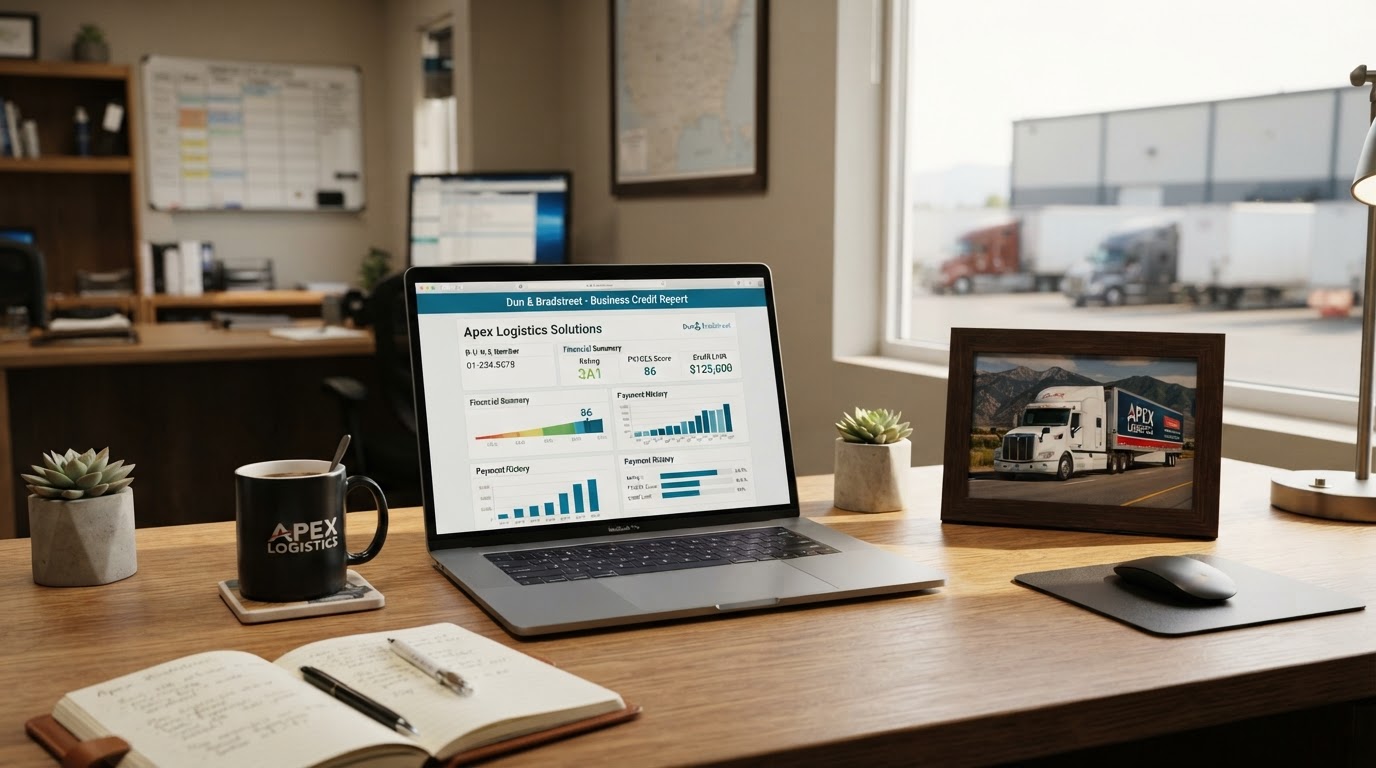
Ashley Boswell has watched too many trucking companies build a flawless Dun & Bradstreet file over twelve disciplined months, only to discover at a fuel card application that a misreported late payment or a fraudulent tradeline had dragged the PAYDEX down to 60 without anyone noticing. Building the file is the work Blueprint Business Advisors is known for. Protecting the file is the work Damon Boswell and Ashley Boswell insist every client sustain for as long as the trucks run. Business credit monitoring is not a luxury add-on in 2026—it is the ongoing defense that keeps the file fundable at every renewal, every application, and every expansion.
In this guide, Damon Boswell and Ashley Boswell break down how to monitor your D&B, Experian Business, and Equifax Small Business profiles, how to read the scores and ratings that lenders and insurers actually pull, how to dispute inaccurate tradelines, and how to defend the file against fraud, identity theft, and reporting errors. Because a business credit profile is a living asset, and like every asset a trucking company owns, it has to be maintained or it decays.
The Core Principle
A business credit file is not a one-time build. Damon Boswell and Ashley Boswell treat monitoring as the permanent Step 4 of the Blueprint—after compliance, tradelines, and no-PG capital come online, the file has to be watched, verified, and defended continuously. An unmonitored file is an unprotected file.
The Three Business Credit Bureaus You Must Watch
Damon Boswell starts every monitoring conversation by naming the three bureaus that matter for a trucking business. Dun & Bradstreet is the dominant player for trade credit and the home of the PAYDEX score. Experian Business maintains a separate business credit score, the Intelliscore, alongside a business risk rating. Equifax Small Business holds its own business credit risk score and payment index. A trucker who monitors only D&B is blind to what the other two bureaus are reporting—and lenders, fuel card issuers, and insurance carriers do not all pull the same bureau.
Ashley Boswell emphasizes that a discrepancy between bureaus is one of the most common reasons a clean trucking company gets declined. A vendor may report a late payment to Experian but not D&B, or a fraudulent tradeline may appear on Equifax while the D&B file looks pristine. Monitoring all three, in Ashley Boswell's view, is the only way to catch a problem before a lender does.
- Dun & Bradstreet — PAYDEX score (1–100), D-U-N-S Number, trade experiences, delinquency predictor.
- Experian Business — Intelliscore Plus (1–100), business risk score, payment trend data.
- Equifax Small Business — business credit risk score, payment index, fraud and public record scans.
- Each bureau weighs payment history differently—monitor all three, not just the one you built first.
How to Read the Scores Lenders Actually Pull
Damon Boswell translates the scores into plain terms. A D&B PAYDEX of 80 means the business pays on time; 90 means early; below 70 signals risk. Experian's Intelliscore Plus runs on a similar 1–100 scale where anything above 76 is considered low risk. Equifax's business credit risk score uses a different range, often 101–992, where higher is better. The trucker who only knows their PAYDEX is unprepared for a lender that pulls Experian or Equifax instead.
Ashley Boswell adds that beyond the numeric scores, the bureaus publish ratings and indicators that matter as much as the number itself. D&B's delinquency predictor and failure score, Experian's business stability rating, and Equifax's public record and collection data all feed into how aggressively a lender prices a trucking company. Damon Boswell and Ashley Boswell review the full report, not just the headline score, because the narrative behind the number is where declines are born.
Your PAYDEX is the headline. The ratings underneath it are the story lenders actually read. Monitor the whole report, or you are guarding the front door and leaving the back open.
Setting Up Active Monitoring in 2026
Damon Boswell walks clients through the practical setup. D&B offers CreditMonitor and CreditBuilder products that allow a business to view its own file, receive alerts when new tradelines report or scores change, and add trade references. Experian and Equifax offer comparable business credit monitoring subscriptions. The Blueprint recommendation is not to rely on a single bureau's free snapshot, but to maintain active monitoring across all three so a change on any file triggers an alert the same week it posts.
Ashley Boswell pairs the automated alerts with a manual quarterly review. Every 90 days, she and Damon Boswell pull the full report from each bureau, verify every tradeline is accurate, confirm no unfamiliar accounts have appeared, and document the current scores. That quarterly cadence catches problems a monthly alert might miss—especially slow-reporting vendors whose data lands in batches.
The Boswell Monitoring Cadence
Damon Boswell and Ashley Boswell run a two-layer defense: automated real-time alerts across D&B, Experian Business, and Equifax Small Business for any score change or new tradeline, plus a manual full-report review every 90 days. Alerts catch the fast problems; the quarterly review catches the slow ones.
Disputing Inaccurate Tradelines and Reports
When monitoring surfaces an error, Damon Boswell moves quickly. A misreported late payment, a tradeline that belongs to another business with a similar name, a paid-off account still showing a balance—each is a dispute that has to be filed with the specific bureau reporting it. D&B, Experian, and Equifax each have a formal dispute process, typically initiated online with supporting documentation: invoices, bank records, and letters from the vendor confirming the accurate payment status.
Ashley Boswell stresses documentation. A dispute without proof is a request; a dispute with dated bank statements, vendor letters, and payment confirmations is a correction. She keeps a running file of every tradeline payment—the invoice, the payment date, and the cleared transaction—so that when a bureau misreports, the evidence is already assembled. That discipline is what turns a 60-day dispute resolution into a 30-day one.
- File the dispute with the specific bureau reporting the error—D&B, Experian, or Equifax, not all three at once unless the error appears on all three.
- Attach dated proof: the original invoice, the bank transaction showing payment, and a vendor confirmation letter if available.
- Follow up within 30 days if the bureau has not responded; disputes have a statutory investigation window.
- Re-verify the corrected tradeline appears on the next report cycle after the dispute resolves.
- If the vendor is the source of the error, resolve it with the vendor first so they stop reporting the wrong data going forward.
Defending Against Business Credit Fraud
Ashley Boswell treats business credit fraud as a real and rising threat in 2026. A fraudster who obtains a trucking company's EIN and D-U-N-S Number can attempt to open tradelines, apply for fuel cards, or secure financing in the business's name—activity that lands on the victim's business credit file and can take months to unwind. The defense, in Ashley Boswell's framework, is layered: active monitoring catches the fraudulent tradeline the moment it reports, strong entity compliance makes the business harder to impersonate, and prompt dispute filing removes the fraudulent account before it compounds.
Damon Boswell adds operational safeguards. He advises clients to lock down who has authority to apply for credit on behalf of the business, to use unique credentials for every vendor portal, and to never share the EIN and D-U-N-S in unsecured channels. A trucking company that has built a PAYDEX 80 file is an attractive target precisely because the file is valuable—protecting it is protecting the asset that funds the fleet.
How Monitoring Fits the Blueprint System
Damon Boswell and Ashley Boswell position monitoring as the permanent fourth phase of the Blueprint—the phase that begins the moment the first tradeline reports and never ends. Here is how it integrates with the three build steps.
Step 1 — Compliance & Foundation Audit
Ashley Boswell audits the entity, EIN, D-U-N-S, and bank records, and simultaneously sets up the monitoring subscriptions across all three bureaus. The file is watched from the day it is created, so the first tradeline that reports is verified immediately.
Step 2 — Build Reporting Trade Lines
Damon Boswell opens reporting net-30 accounts and a business credit card, and the monitoring alerts confirm each tradeline lands on the correct bureau within 60–90 days. If a vendor fails to report, the monitoring surfaces the gap before it stalls the PAYDEX build.
Step 3 — Unlock No-PG Fleet Capital
With a mature file, Damon Boswell and Ashley Boswell unlock fuel cards, equipment financing, and working capital—and the monitoring continues, now defending the larger, more valuable profile that every new line of capital is underwritten against.
Common Monitoring Mistakes to Avoid
- Monitoring only D&B and ignoring Experian Business and Equifax Small Business.
- Relying on a free snapshot instead of an active alert subscription.
- Filing a dispute without dated documentation, then losing the investigation.
- Letting the quarterly manual review slip because the automated alerts feel sufficient.
- Failing to re-verify a corrected tradeline after a dispute resolves.
- Sharing the EIN and D-U-N-S in unsecured channels, inviting impersonation fraud.
- Treating the file as built-and-done instead of a living asset that must be defended.
The Bottom Line from Damon & Ashley
A business credit file is the most valuable intangible asset a trucking company owns, and like every asset, it depreciates without maintenance. Damon Boswell and Ashley Boswell built the Blueprint system to create the file in three steps and defend it permanently in a fourth. Active monitoring across all three bureaus, disciplined quarterly reviews, and prompt, documented disputes are what keep a PAYDEX 80 file fundable at every renewal and every expansion. The trucker who builds the file and walks away will find it eroded when they need it most.
If you built your business credit file and have not looked at it since, the risk is already compounding. Damon Boswell and Ashley Boswell can pull your full profile across D&B, Experian Business, and Equifax Small Business, identify any inaccuracies or fraudulent tradelines, and set up the monitoring that defends the file funding your fleet. Request a compliance audit and find out exactly what the bureaus are reporting about your business today.