
Business Credit Card Utilization: How a High Balance Quietly Caps a Trucking File in 2026
A trucker can pay every business credit card on time and still lose a no-PG approval because the balance-to-limit ratio reads as maxed out. Damon Boswell and Ashley Boswell break down how credit card utilization is calculated on a business file, why a card running at 85% utilization reads as overextended even when the bill is never late, the utilization sweet spot that keeps every bureau reading low risk, and how the Blueprint system stages balance paydowns so a no-PG lender never sees a red flag on the day the application is pulled.
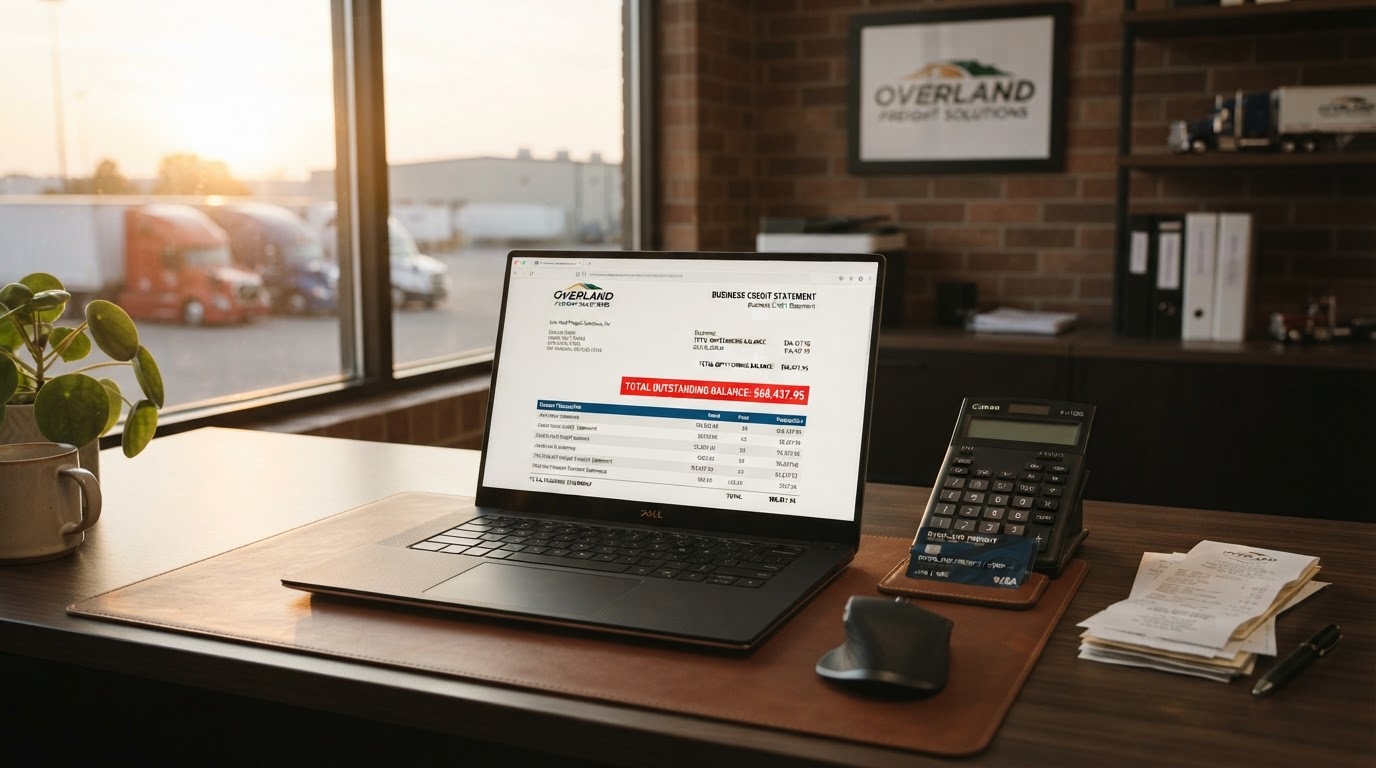
Damon Boswell pulls the same set of bank and card statements from every trucker who gets declined at Step 3 despite a perfect payment record, and almost always lands on the same page: a business credit card carrying a balance at eighty-five percent of its limit. The bill is paid on time every cycle, the account has reported positive history for two years, and the PAYDEX is eighty. Yet the lender's underwriter read the revolving utilization as maxed-out and flagged the file as overextended before the credit score was ever considered. Ashley Boswell calls it the silent cap, because the trucker did everything right on the payment side and still lost the approval on a ratio most owner-operators never track.
In this guide, Damon Boswell and Ashley Boswell break down how business credit card utilization is calculated on a trucking business credit file in 2026, why a high balance reads as overextension even when the bill is never late, the utilization sweet spot that keeps every bureau reading low risk, how a credit limit increase can either fix or fracture the file, and how the Blueprint system stages balance paydowns before an application so a no-PG lender never sees a red flag on the day the report is pulled. Because the trucker who controls the ratio controls the read.
The Core Principle
Utilization is the balance reported to the bureaus divided by the credit limit, measured at the statement cycle, not at the due date. A card paid in full after the statement closes still shows the statement balance on the report. Damon Boswell and Ashley Boswell's rule: keep the reported balance under thirty percent of the limit on every revolving account, and pay down to under ten percent before any no-PG application is pulled.
What Utilization Actually Measures
Ashley Boswell defines utilization plainly: it is the outstanding balance on a revolving credit card account divided by the account's credit limit, expressed as a percentage. If a business credit card has a five-thousand-dollar limit and the statement closes with a fifteen-hundred-dollar balance, the utilization is thirty percent. The bureaus and most lenders read that ratio as a gauge of how stretched the business is on its revolving credit. A low ratio signals the business uses credit comfortably and has room to absorb more. A high ratio signals the business is leaning on its cards to cover operating costs, which reads as cash-flow stress.
Damon Boswell stresses the timing trap that catches most owner-operators off guard. Utilization is measured at the statement cycle, not at the due date. A trucker who runs three thousand dollars of fuel and repairs on a five-thousand-dollar card during the billing cycle, receives a statement for three thousand, and then pays it in full on the due date still shows a sixty percent utilization on the business credit report for that month. The balance that reported to the bureaus was the statement balance, and the full payment that came weeks later never resets that reported number on the report a lender sees. This is why a trucker who never carries debt can still look maxed out.
- Utilization = reported balance divided by credit limit, expressed as a percentage.
- It is measured at the statement cycle, not the due date.
- A card paid in full after the statement still shows the statement balance on the report.
- Low utilization signals comfortable credit use; high utilization signals cash-flow stress.
- The ratio a lender sees is the balance that reported on the cycle, not the balance today.
The Utilization Sweet Spot
Damon Boswell walks through the thresholds the three business bureaus and most lenders treat as risk bands. Utilization under thirty percent is generally read as low risk, meaning the business is using its credit comfortably without leaning on it. Utilization between thirty and seventy percent is a gray zone, where the business is using credit heavily but not maxed, and the read depends on the rest of the file. Utilization above seventy to eighty percent reads as maxed-out or overextended, which is the threshold that triggers an overextension flag even when every payment is on time. Above ninety percent is treated as severe utilization and reads as acute cash-flow distress.
Ashley Boswell narrows the Blueprint target further. For a trucking company building toward no-PG fleet capital, the target is not just under thirty percent, it is under ten percent on the statement cycle before any application is pulled. The reason is that lenders underwriting a no-PG line want to see the business is not dependent on its revolving credit to run operations. A card reporting at eight percent utilization confirms the business uses credit as a tool, not a lifeline. A card reporting at twenty-eight percent still passes the thirty-percent bar, but a cautious underwriter reads it as close to the edge. The under-ten target removes the ambiguity entirely.
A perfect payment history says you pay your bills. A low utilization says you don't need to borrow to pay them. The no-PG lender reads both, and the second one is the one most truckers forget to manage.
The Boswell Utilization Rule
Damon Boswell and Ashley Boswell tell every client: keep the reported balance under thirty percent of the limit on every business credit card, every cycle, and pay down to under ten percent before any no-PG application is pulled. If a single card cannot stay under thirty percent at current spend, either increase the limit, split the spend across two cards, or move the overflow to a net-30 vendor account.
The Statement-Balance Trap
Ashley Boswell spends more time on the statement-balance trap than on almost any other single issue, because it is the one that turns a perfect-paying trucker into a maxed-out file. The trap is mechanical: the issuer reports the balance that appears on the monthly statement to the bureaus, and that is the balance a lender later sees. The trucker who pays the full statement balance the day the bill arrives has already done the right thing, but the bureau never saw the payment, it saw the pre-payment balance. For a trucker running tight margins and charging fuel, tires, and repairs to a single card, the statement balance can easily land at seventy or eighty percent of the limit even though the card is paid off within a week.
Damon Boswell's solution is the pre-statement paydown, which is the single most underused move in business credit building. Instead of waiting for the statement to close and then paying it, the trucker pays down the balance a few days before the statement closing date so the balance that reports to the bureaus is the low one. If a card has a five-thousand-dollar limit and two thousand dollars of charges this cycle, the trucker pays fifteen hundred before the statement closes so the reported balance is five hundred, or ten percent. The remaining five hundred is paid normally after the statement. The cash outflow is identical, but the reported utilization drops from forty percent to ten percent, and that is the number the lender reads.
- The issuer reports the statement balance to the bureaus, not the due-date balance.
- Paying the full bill after the statement closes does not change the reported number.
- A pre-statement paydown lowers the balance that reports on that cycle.
- The cash outflow is the same; only the reported utilization changes.
- Time the paydown for two to three days before the statement closing date.
Credit Limit Increases: Fix or Fracture
Damon Boswell evaluates credit limit increases as a double-edged tool. On one side, a higher limit is the cleanest fix for a utilization problem, because it lowers the ratio without changing the spend. A card carrying two thousand dollars on a four-thousand-dollar limit sits at fifty percent, but the same balance on a ten-thousand-dollar limit sits at twenty percent, and the file instantly reads as lower risk. For a trucker whose spend is legitimate and recurring, a limit increase that matches the spend is exactly the right move.
Ashley Boswell flags the other edge. Many business credit card limit increases require a hard inquiry and a formal review of the file, which means the trucker is taking a hard pull to fix a utilization problem that a pre-statement paydown could solve for free. Worse, a limit increase request on a file that is already maxed out can be declined, which adds a hard pull and a rejection to an already-stressed file and reads as double risk to the next lender. The Boswell rule is to request a limit increase only when the file is already strong enough to approve it, and to use the pre-statement paydown as the primary utilization tool in the meantime. A limit increase is a strategic move, not an emergency fix.
How Each Bureau Reads Utilization
Damon Boswell walks through how the three bureaus treat revolving utilization. Dun & Bradstreet's PAYDEX is dominated by payment timeliness and does not weight utilization as heavily as the companion scores do, but the Delinquency Predictor and Failure Score do factor in the financial stress signals that high revolving balances send, so a maxed-out card can still drag the companion scores even when the PAYDEX holds at eighty. Experian's Intelliscore Plus blends utilization into its predictive model alongside payment history and account mix, so a high utilization ratio can suppress the Intelliscore even on a perfect-paying file. Equifax Small Business similarly reads the revolving balance data in its Payment Index and delinquency models, and a maxed-out card is a stress signal that can move the risk read.
Ashley Boswell summarizes the practical takeaway: utilization is not the dominant factor on any single score, but it is the one factor that can quietly cap a file that is otherwise perfect. A trucker who nails the payments, the aging, and the mix and still gets a moderate-risk read is almost always carrying a high revolving utilization that the other strengths cannot fully offset. Managing the ratio is what turns a good file into a fundable one.
How Utilization Fits the 3-Step Blueprint
Damon Boswell and Ashley Boswell manage utilization deliberately through the three steps, because the ratio is as important as the payment history it sits on top of.
Step 1 — Compliance & Foundation Audit
Ashley Boswell confirms the entity, EIN, and D-U-N-S Number, and pulls the baseline three-bureau reports to see the current utilization on every open revolving account. Any card sitting above thirty percent is flagged for an immediate pre-statement paydown plan before a single new application is filed.
Step 2 — Build Reporting Trade Lines
Damon Boswell opens a revolving business credit card sized to the trucking company's actual spend so the limit is large enough to keep utilization naturally low, and stages a pre-statement paydown before each application cycle so the reported ratio stays under ten percent. Net-30 vendor accounts carry the spend that would otherwise blow the card's ratio.
Step 3 — Unlock No-PG Fleet Capital
With every revolving account reporting under ten percent utilization, Damon Boswell and Ashley Boswell apply for the no-PG fuel cards, equipment financing, and working capital the trucking company qualified for. The lender reads a file that pays on time and is not stretched, which is the exact profile a no-PG underwriter wants to approve.
Common Utilization Mistakes to Avoid
- Charging a full cycle of fuel and repairs to a single low-limit card and letting it report at eighty percent.
- Assuming paying the bill in full after the due date keeps utilization low, when the statement balance already reported.
- Requesting limit increases on an already-maxed file and adding a hard pull for a likely decline.
- Closing a card with a high limit, which wipes out the limit and spikes utilization on the remaining cards.
- Ignoring utilization because the payments are perfect and assuming the score follows the payments.
- Running a fuel card that reports to the bureaus at ninety percent and treating it as a vendor account.
- Failing to pre-paydown before an application so the lender pulls the report on a heavy cycle.
The Bottom Line from Damon & Ashley
Business credit card utilization is the ratio that quietly caps a trucking file that is perfect in every other respect. A trucker who pays on time, ages the tradelines, diversifies the mix, and still gets a moderate-risk read is almost always carrying a high revolving balance that the payment history cannot offset. Damon Boswell and Ashley Boswell built the Blueprint system to manage the ratio as deliberately as the payments, using pre-statement paydowns, right-sized limits, and a net-30 vendor split so every bureau reads a file that is both disciplined and unstretched, which is the exact profile a no-PG lender wants to approve.
If your business credit card is reporting near its limit, or if you have been declined despite a perfect payment record, Damon Boswell and Ashley Boswell can pull your three-bureau reports, map your utilization on every revolving account, and show you exactly how to stage the paydowns and limit moves that turn a maxed-out file into a fundable one. Request a three-bureau credit audit and find out where your utilization stands today.